A component can be available today and still be a risk to the next production run. That contradiction is becoming harder for electronics teams to ignore. In Lytica’s October 2026 component-market data, memory availability stood at 96.5%, even as the category’s lead-time index jumped 57.3% in a single month.
For an engineer reviewing a bill of materials, those two numbers tell different stories. One says parts can still be found. The other says replacing that stock later may take considerably longer.
The number that hides behind availability
Consider a small hardware team preparing the next batch of an industrial sensor. Its prototype uses a specific memory component. The distributor page shows available stock, so purchasing looks straightforward. But if factory replenishment takes longer than expected, a second or third batch can suddenly inherit a schedule problem that the initial BOM never revealed.
That is a hypothetical scenario, not a documented supplier failure. Yet it illustrates the distinction in Lytica’s November 6 report. Its market basket tracks about 165,000 components across more than 30 categories. Memory’s October lead-time index rose 57.3%, with its price index up 5.36%, while current availability remained 96.5%. Those are category-level indicators, not quotations for an individual part number.
The broader market was much less dramatic: Lytica’s overall lead-time index increased 1.92% and overall component prices increased 0.48% month over month. That contrast matters. Electronics supply risk is not evenly distributed across the BOM.
AI demand is changing what counts as a safe component choice
The pressure is not confined to memory. Lytica recorded lead-time index increases of 19.5% for power, 18.6% for communication components and 17.7% for processors in October. Meanwhile, some other categories saw shorter lead times. The pattern is selective, not a universal semiconductor shortage.
A separate November 12 supply-chain report from ERSA Electronics describes pressure in certain high-capacitance capacitors and analog components, while noting that conditions vary between high-end and consumer-oriented component families. That reinforces a practical point: the label “capacitor” or “memory” is too broad to decide sourcing risk. Package, grade, exact manufacturer part number, approved alternatives and delivery date all matter.

What engineers should ask before approving the BOM
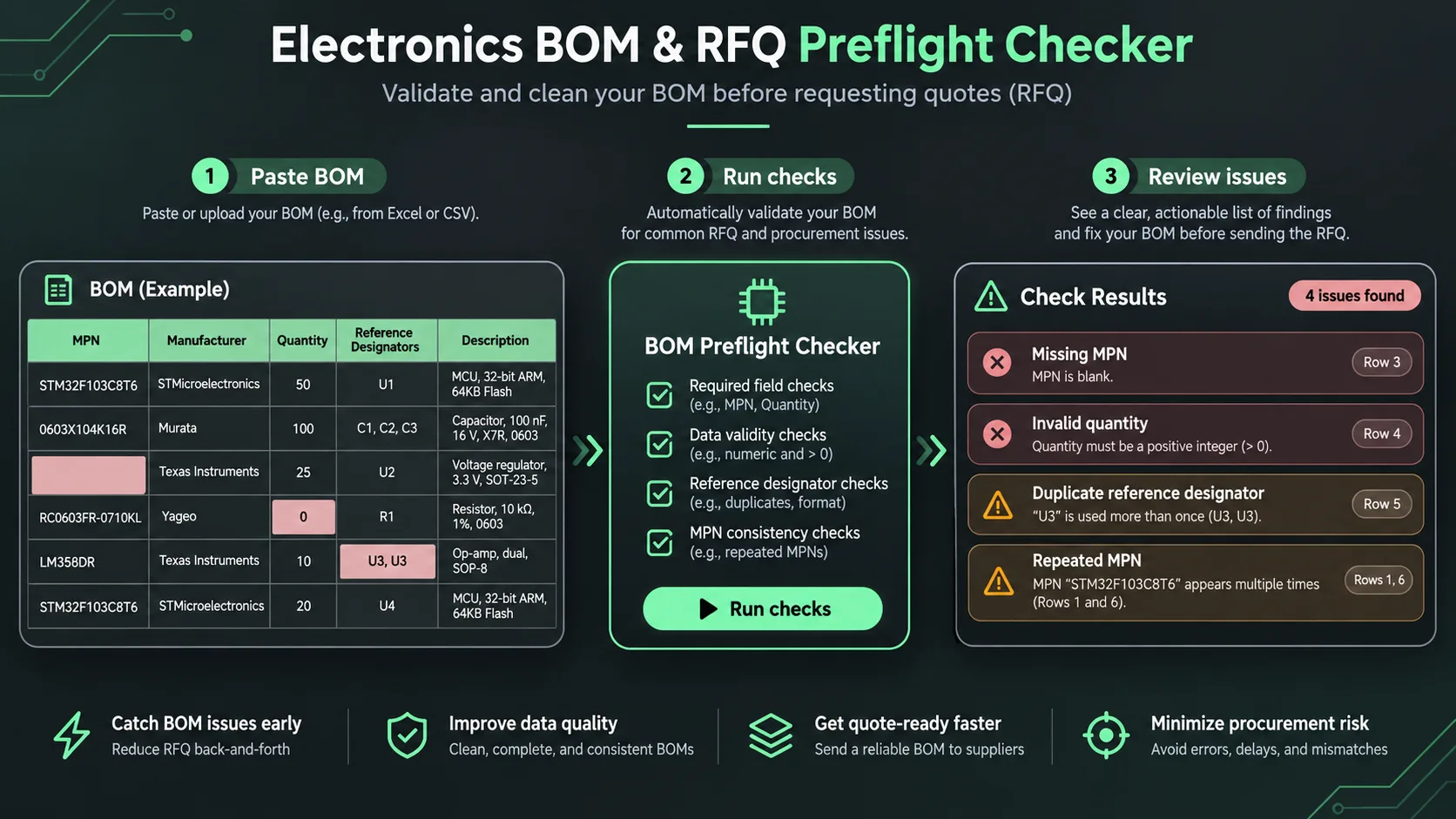
A clean BOM is still essential: exact manufacturer part numbers, unambiguous quantities, reference designators and revision control make manufacturing quotations more reliable. But documentation quality and supply assurance are different checks.
- Validate the exact MPN. Category-level market reports cannot tell you whether a specific chip is available for the required production date.
- Ask for supplier-confirmed replenishment timing. Current distributor stock should not be treated as a factory delivery commitment.
- Review alternate components with engineering approval. Pin compatibility alone does not establish electrical, firmware or environmental equivalence.
- Separate prototype and production demand. A few sample units being available does not guarantee the next thousand can be purchased on time.
- Record the date of every sourcing assumption. A quotation is a snapshot, not a permanent property of the design.
The engineering decision comes before the purchase order
The most expensive BOM problem is not always a missing cell in a spreadsheet. Sometimes it is the assumption that a component found today will be just as easy to source when the product scales.
WireUnWired’s free BOM preflight tool is designed for basic formatting and reference checks, not live stock or supplier verification. Its browser functionality is currently under repair, so teams should not rely on it for production decisions. For a human-scoped documentation review, see our engineering research services.
Source notes: Lytica, “State of the Electronic Components Market: October 2026,” published November 6, 2026; ERSA Electronics, “Electronic Components Monthly Market Report,” published November 12, 2026. Lead-time and price changes cited above are report indices, not universal changes in every vendor quotation.
Discover more from WireUnwired Research
Subscribe to get the latest posts sent to your email.