
Ever wondered why your LTE smartwatch is dead by evening? You charge it at night, wear it all day, and by 3 PM it’s a black rectangle on your wrist. You probably blamed the battery. Most people do.
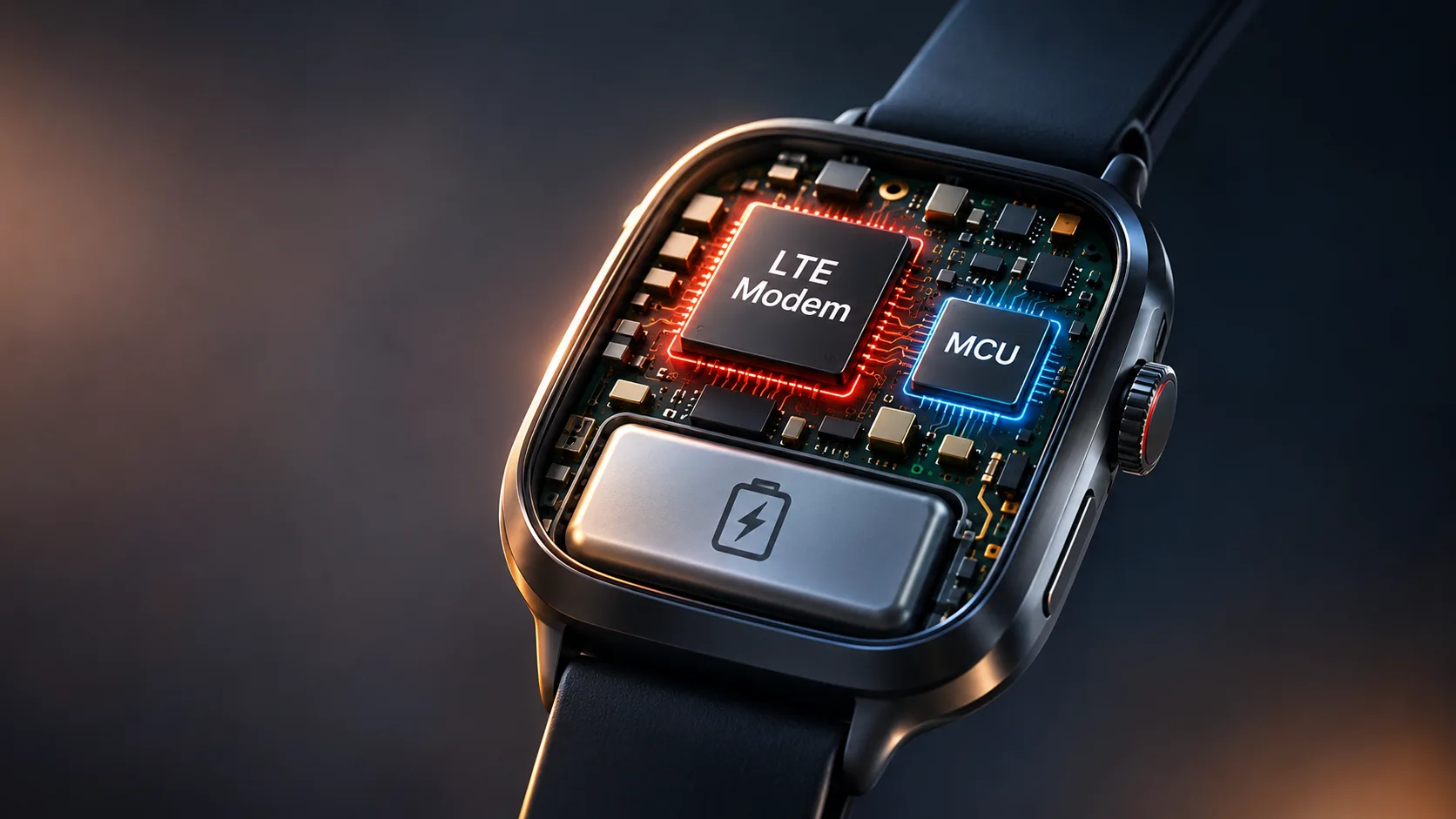
But the battery only half part of the story. The real culprit is the modem, the little chip that talks to Jio or Airtel. It’s the hungriest thing on the board, and in most watches it never really sleeps. Think of it as a guest who stays up all night with every light switched on.
So how do engineers get a tiny 300 to 450 mAh battery to last days? They stop the modem from running the show. Here are the four fixes that help them give you a better battery life.
Fix one: give the watch a different brain. Instead of letting the cellular chip run the screen, sensors, and UI, designers add a tiny ultra-low-power MCU (an ARM Cortex-M33 from Nordic, Ambiq, or STM32) to handle everyday work. The LTE modem sits behind a load switch that cuts its power completely. It wakes only when something real happens: an SOS press, a call, a dropped Bluetooth link, or a scheduled sync.
Fix two: teach the modem to nap. A phone checks the tower for calls every 1.28 seconds. Your wrist doesn’t need that. With eDRX(Extended Discontinuous Reception ), the gap stretches to 10.24 or 20.48 seconds, and the receiver stays off for over 95% of standby. A call takes a few seconds longer to ring, and nobody notices. One catch: the network decides the final timer, so test on live Jio and Airtel towers early.
Fix three: stop texting the cloud every minute. Every upload leaves the modem burning power for seconds afterward, a drain called tail energy. So the watch logs heart rate, steps, and GPS to flash memory and sends one compressed batch every 15 to 30 minutes. Real-time sending is saved for emergencies like SOS, geofence alerts, and live tracking.
Fix four, the sneaky one: the antenna. A watch pressed against skin soaks up RF, and a badly matched antenna makes the modem shout at maximum power (+23 dBm), pulling 500 to 800 mA peaks. Engineers add a Pi-network matching circuit at the antenna feed, tune it with a VNA(Vector Network Analyzer) after final assembly for Indian Bands 5 and 40, and keep metal bezels, battery foil, and display cables out of the antenna zone.
Now picture that same watch with all four fixes. Same battery, same wrist, but the modem sleeps through the day and wakes only when it matters.
The best power saving in a cellular wearable is the transmission you never make.
Discover more from WireUnwired Research
Subscribe to get the latest posts sent to your email.