
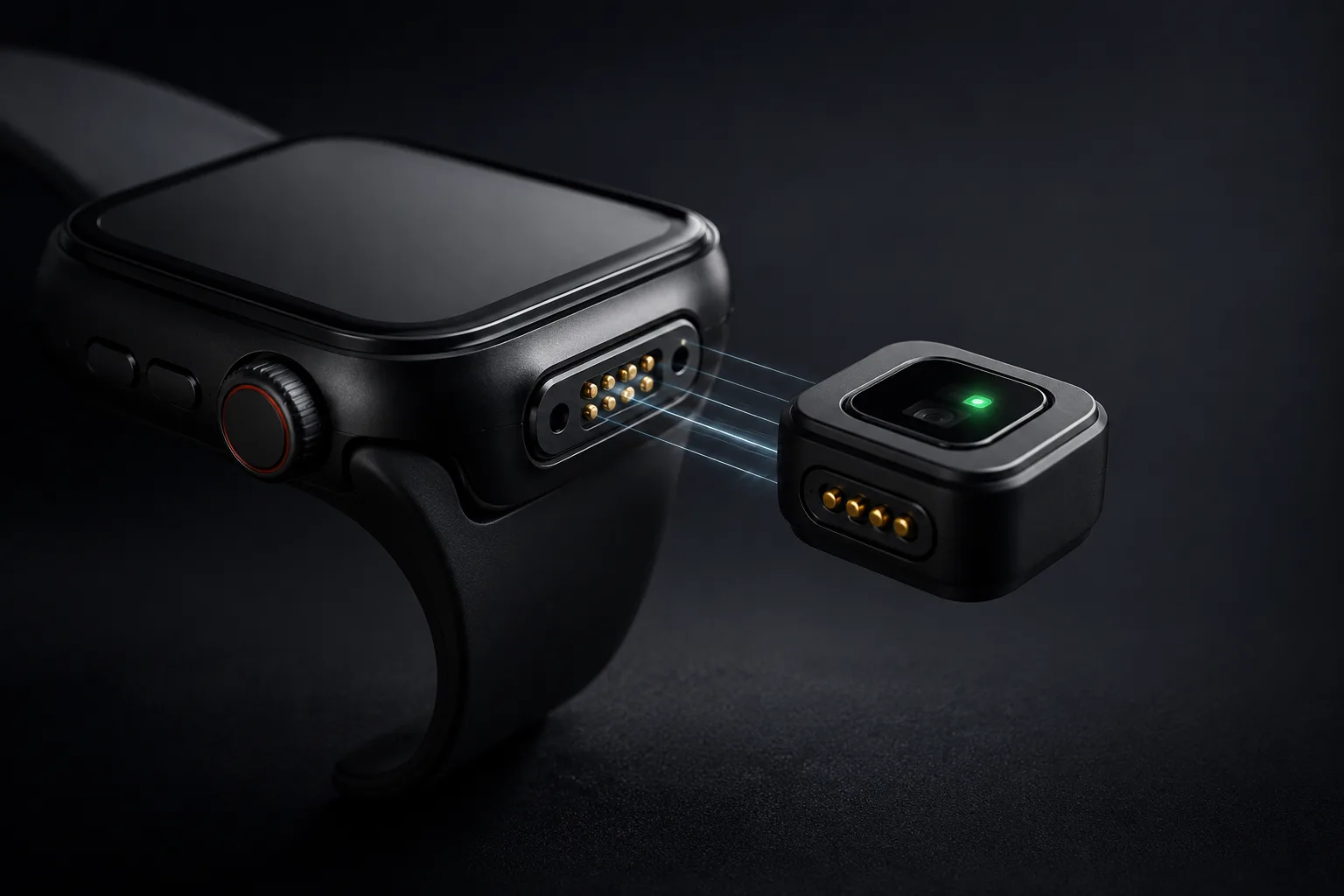

Wearable technology has advanced rapidly over the past decade. Smartwatches and other connected devices can now monitor movement, heart rate, sleep, environmental conditions and a growing range of physiological signals. Yet there is still a fundamental limitation in how most wearables are designed:
Their hardware capabilities are largely fixed at the time of manufacture.
That creates an interesting contradiction.
Software can be updated overnight, but hardware generally cannot evolve at the same pace. When a new sensor or capability becomes important, users often have only one option—replace the device.
What if wearables were designed differently? What if the core device could remain useful while new capabilities were added over time?
This is where modular wearable architecture becomes particularly interesting.
From a Product to a Platform
Most wearables are designed as complete products. The processor, sensors, battery, communication hardware and enclosure are integrated into a single system. This approach offers advantages in size, reliability and manufacturing simplicity, but it also limits future expansion.
A modular architecture takes a different approach. Instead of designing a wearable as a fixed collection of sensors, engineers can design it as a core platform with an expansion interface. Additional modules could potentially introduce new sensing capabilities, communication functions or specialized features without requiring the entire wearable to be replaced.
The concept is similar to how computers evolved from fixed systems into platforms capable of supporting different peripherals and upgrades. For wearables, however, the challenge is significantly greater because the system must remain compact, lightweight, comfortable and reliable while operating close to the human body.
The Electronics Behind Modularity
Physical attachment is only one part of creating a modular wearable. The electronic architecture must also allow the core device and the accessory to communicate effectively.
A modular interface might include dedicated power connections along with digital communication lines. For example, I²C uses two primary communication lines—SDA for data and SCL for the clock signal—to allow a host controller to communicate with compatible sensors and peripherals. Other connections could provide general-purpose digital signals through GPIO pins or an interrupt (INT) line. An interrupt can allow an external module to notify the main controller when a specific event occurs, rather than requiring the controller to continuously check the module.
These seemingly simple connections become important when building a system intended to support multiple types of accessories.
The Problem of Identification
Once different modules can be attached to the same device, another question immediately appears:
How does the wearable know what has been connected?
One possible solution is resistor-based identification. Different modules can be designed with different resistance values, allowing the main system to measure the resulting electrical signal and determine which accessory is present.
Another approach is to place a small microcontroller, or MCU, inside the accessory itself. A microcontroller is essentially a compact programmable computer capable of reading sensors, processing information and communicating with other electronics. A module equipped with an MCU could potentially identify itself digitally and provide information about its capabilities.
That could make the system considerably more flexible. Instead of the wearable simply knowing that “something is attached,” it could potentially determine “which module is attached and what it can do.”
This opens the door to more intelligent configuration and device management.
Magnetic Interfaces and Pogo Pins
The mechanical connection is equally important.
One interesting approach is the combination of magnets and pogo pins. Magnets can help guide and hold an accessory in the correct position, while spring-loaded pogo pins establish electrical contact.
This could make accessories easier to attach and remove while avoiding some of the bulk associated with conventional connectors. But modularity introduces new engineering challenges. Electrical contacts must remain reliable over repeated use. Designers must consider accidental short circuits, mechanical wear, corrosion, waterproofing, alignment and protection against environmental conditions.
In a wearable, these issues become even more significant because the device may experience sweat, movement, temperature changes and repeated physical contact.
A modular interface, therefore, is not simply a connector. It is a complete mechanical, electrical and software design problem.
Why Modularity Ma
Safety requirements are not static. New sensors, algorithms and detection methods continue to emerge. Different environments also create different requirements. A person working in an industrial environment may require different capabilities from someone using a wearable for everyday personal safety. A future application could require sensors or communication capabilities that do not exist in today’s consumer devices.
yday personal safety. A future application could require sensors or communication capabilities that do not exist in today’s consumer devices.A fixed hardware architecture can make such evolution expensive.
A modular architecture could potentially allow the same core platform to support different configurations as requirements change.
That could extend the functional life of the hardware while allowing innovation to happen at the module and software levels.
Toward More Adaptable Wearables
The larger idea is bigger than simply adding accessories.
Modularity can change the definition of what a wearable actually is. Instead of thinking of a wearable as a finished product containing a predetermined set of features, we can begin to think of it as an evolving platform.
The core system could provide computing, communication and basic sensing, while additional capabilities could potentially be introduced through compatible modules. Such an approach could reduce hardware obsolescence and create new possibilities for personalization, specialization and long-term development.
There will, of course, be difficult questions around power consumption, reliability, security, waterproofing, thermal constraints, cost and interoperability. Designing a flexible architecture is significantly more challenging than designing a closed device. But the potential payoff is equally significant.
A growing number of companies and innovators are beginning to explore this direction. One such company is Elymentals, a human-safety technology company working toward a future where wearable technology is not simply smarter, but more adaptable to changing human needs and emerging technologies.
The broader question is whether the next generation of wearables should be designed as products that are complete on the day they are purchased—or as platforms capable of evolving long after they leave the factory.
If wearable technology continues moving in that direction, the most valuable device of the future may not be the one that can do everything today—but the one designed to become capable of doing more tomorrow.
Explore Elymentals → Building the future of human-safety technology.
For context, see SpaceX launches 27 Starlink satellites from California on….
Discover more from WireUnwired Research
Subscribe to get the latest posts sent to your email.