NASA’s Webb Provides Crash Course on Planet-Shattering Collisions
Astronomers using NASA’s James Webb Space Telescope have examined a rare group of young stellar systems known as extreme debris disks. These systems contain unusually high amounts of warm dust close to the star, where rocky planets typically orbit.
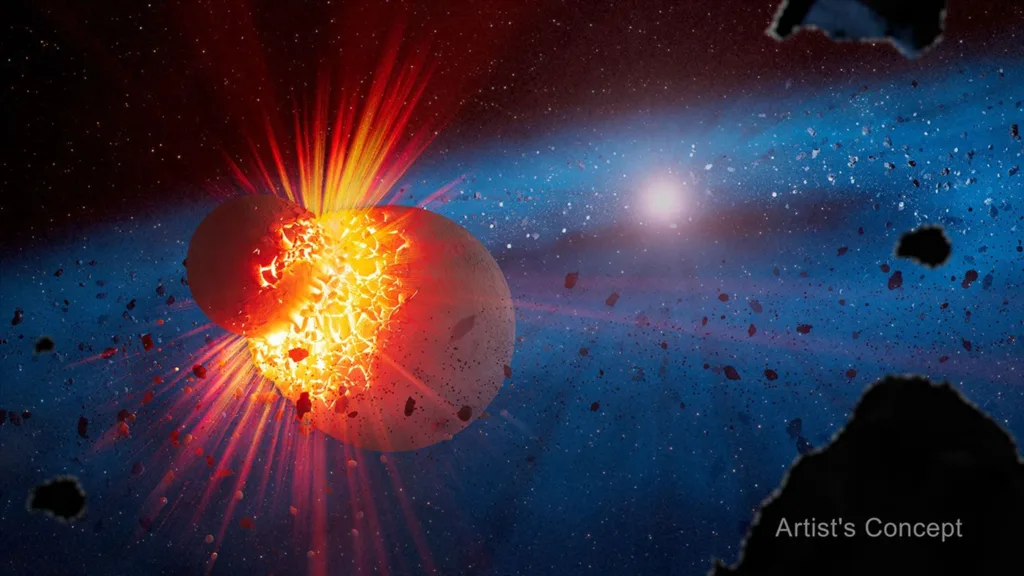
Astronomers using NASA’s James Webb Space Telescope have examined a rare group of young stellar systems known as extreme debris disks. These systems contain unusually high amounts of warm dust close to the star, where rocky planets typically orbit. Led by Kate Su of the Space Science Institute, a research team studied a sample of 21 extreme debris disks.
These included 16 observed by Webb and five from archival data collected by the retired Spitzer Space Telescope. The observations show that extreme debris disks are rare, appearing around only about 1% of young stars. By analyzing mid-infrared light spectra, the team found that the disks fall into two categories: silica-rich and silica-poor.
Silica-rich disks likely result from high-energy impacts between Mars-sized objects, while silica-poor disks form from lower-energy impacts between Moon-sized bodies. Researchers hope these findings will help explain how rocky planets form and evolve, offering clues about the early history of our own solar system.
Original publication: 1 October 2026 19:30