Mars’ Potato‑Chip Rocks and Ghostly Silica May Reveal Ancient Water and Life
On Mars, a potato‑chip‑shaped rock could be a clue to ancient water.
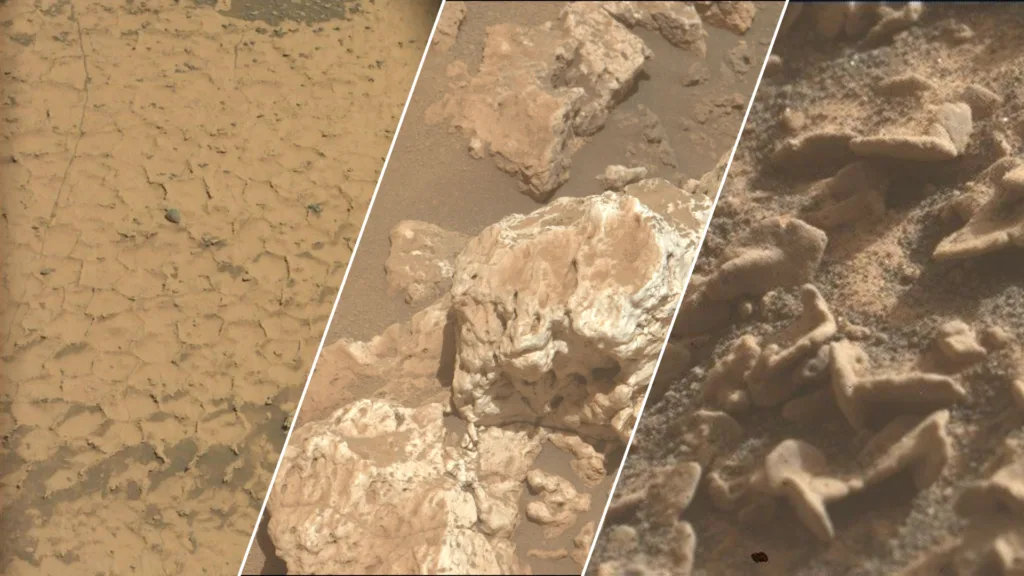
On Mars, a potato‑chip‑shaped rock could be a clue to ancient water. Curiosity’s recent drilling campaign at the Nazca site—named for its resemblance to the South American dish—produced thin, disk‑shaped crystals that the mission team likened to potato chips. The rover’s Mars Hand Lens Imager (MAHLI) captured the formations on Sol 5067, the 5,067th Martian day, while ChemCam and the onboard Sample Analysis at Mars (SAM) instrument examined their chemistry.
These tiny, flat rocks suggest that water once flowed through the bedrock, leaving behind mineral deposits that now preserve a record of Mars’ past climate. Perseverance has turned its attention to the Idubi area outside Jezero Crater, where unusually bright, pale rocks stand out against the dust‑covered terrain.
SuperCam data show the formations are rich in hydrated silica, a mineral that on Earth forms in hydrothermal or groundwater settings. Such silica can trap microscopic fossils, making the Idubi rocks a prime target for searching evidence of ancient life. The rover’s Mastcam‑Z captured the bright rocks on Sol 2023, and its instruments are now probing their composition in greater detail.
Curiosity’s latest images from Mount Sharp reveal polygon‑shaped patterns outlined by raised ridges.
The patterns, photographed on Sol 5073, resemble those seen earlier on the mountain’s layered slopes.
Scientists suggest they could result from mineral shrinkage as water evaporated, temperature swings, or the compaction of buried sediments.
By studying the cementing material around the ridges, researchers hope to pinpoint which process dominated.
Together, these discoveries underscore how Mars’ seemingly barren landscape can unlock secrets of its watery past.
As Curiosity climbs higher and Perseverance investigates older terrains, the rovers are piecing together a complex geological history that may hold clues to life.
The next step will be to confirm whether the hydrated silica preserves any microbial signatures.
Sources & updates
AI-assisted brief based on the original reporting.
Original report: Space.com
Source published: 23 Nov 2026, 22:30
Image credit: Space.com
The story so far
Earlier coverage connected by shared names and topics. Follow the dates to see how coverage developed; these links do not imply every article describes the same event.
 A Grid of 49 Punctures Reveals How Curiosity Bores Into Mars
Forty-nine neat gray, brown, and reddish-orange rings now map a decade of chemical sampling on Mars. NASA released a new seven-by-seven photo…
Connected by: Mars Hand Lens ImagerEARLIER COVERAGE- How a Dying Spacecraft Solved the Mystery of Mars
Solar wind stripped away the ancient atmosphere of Mars, transforming a wet world into a frozen desert. NASA launched the MAVEN orbiter…
Connected by: MarsEARLIER COVERAGE - Forty-Nine Holes Later, Curiosity Keeps Drilling Into Mars
Forty-nine distinct scars now mark the Martian surface where NASA's Curiosity rover has bored into rock to sample the planet. A newly…
Connected by: CuriosityEARLIER COVERAGE - Two NASA Mars Explorers Sidelined by Critical Technical Glitches
Two of NASA's veteran Mars explorers are currently sitting idle following a pair of sudden technical failures. The Perseverance rover and the…
Connected by: PerseveranceEARLIER COVERAGE - NOWMars’ Potato‑Chip Rocks and Ghostly Silica May Reveal Ancient Water and LifeCURRENT UPDATE



Original publication: 23 November 2026 22:30