
Dragonfly’s New Cameras Set to Reveal Titan’s Hidden Secrets
NASA’s Dragonfly rotorcraft is getting its eyes on Titan. Seven high‑resolution cameras, built by Malin Space Science Systems, have been installed in insulated housings that keep them warm in Titan’s –290°F environment.
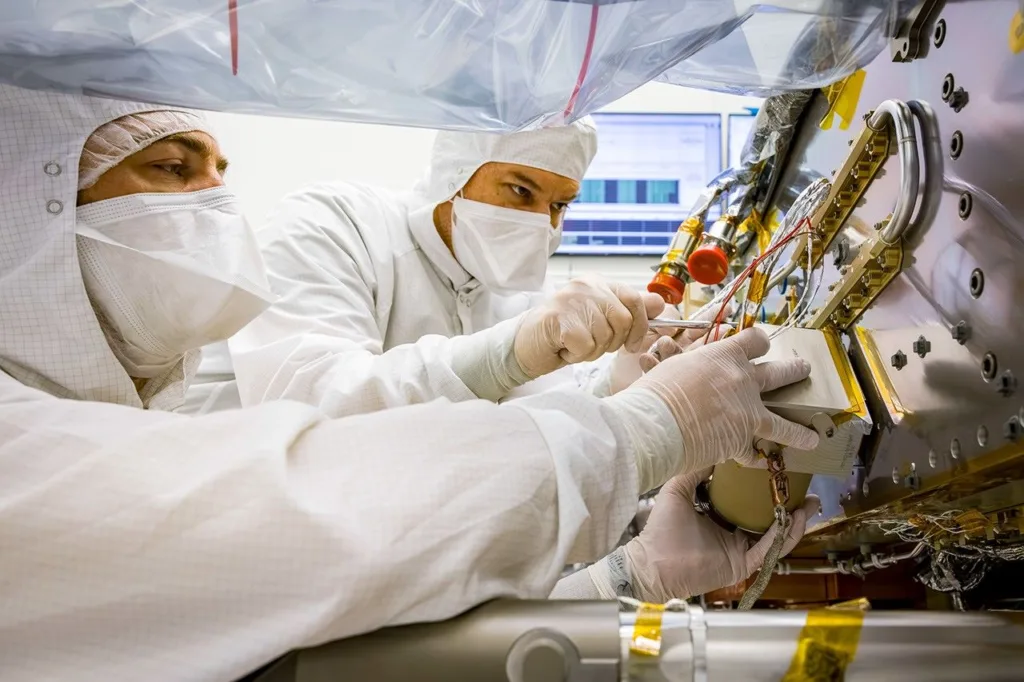
NASA’s Dragonfly rotorcraft is getting its eyes on Titan. Seven high‑resolution cameras, built by Malin Space Science Systems, have been installed in insulated housings that keep them warm in Titan’s –290°F environment. Each camera looks out through a foam‑sealed window, while a configurable LED array lights the scene from infrared to ultraviolet, letting the craft spot organic molecules that glow under UV light.
The camera system is more than a snapshot tool. Two forward‑mounted cameras—a wide‑angle with a 90‑degree field of view and a medium‑angle that overlaps it at higher resolution—provide a stereoscopic view of the terrain ahead. Two side‑mounted wide‑angle cameras stitch together panoramic vistas, and two downward‑facing units help the team pick safe landing spots for DrACO, the drill that will collect samples.
“Seeing Titan from perspectives we’ve never had before is the most exciting part,” said principal investigator Elizabeth Turtle. DragonCam will give scientists both sweeping panoramas and detailed close‑ups, allowing them to link the samples DrACO will bring back to the broader geology of the moon. The LED illumination also lets the cameras mimic human vision, producing images that, while tinted yellow, reveal the true colors of Titan’s surface.
During the moon’s eight‑day night, the UV capability may even identify fluorescent organics, offering clues to prebiotic chemistry.
Dragonfly is slated to launch in July 2028 and arrive at Titan in late 2034.
With DragonCam now integrated, the mission team is one step closer to mapping Titan’s landscape and unlocking its secrets.
Sources & updates
AI-assisted brief based on the original reporting.
Original report: NASA — Recently Published
Source published: 24 Nov 2026, 21:14
Image credit: NASA — Recently Published
The story so far
Earlier coverage connected by shared names and topics. Follow the dates to see how coverage developed; these links do not imply every article describes the same event.
 A Hidden Companion Is Fueling a Fake Supernova Every 113 Days
For fifteen years, a massive star thirty million light-years away has repeatedly flashed bright enough to mimic its own death. This unstable…
Connected by: HiddenEARLIER COVERAGE- How NASA Plans to Hunt Hidden Exoplanets Using Gravitational Waves
Invisible planets may soon reveal themselves through ripples in the fabric of space itself. Scheduled for launch in the mid-2030s, the European…
Connected by: HiddenEARLIER COVERAGE - New NASA Documentary Reveals the Hardest Parts of Building Europa Clipper
Building a spacecraft capable of surviving the severe radiation fields around Jupiter requires more than clever engineering. It demands surviving a global…
Connected by: SpaceEARLIER COVERAGE - Northrop Grumman Secures $290 Million Contract for Next-Gen Weather Satellites
A single federal contract spans nearly two decades to overhaul how meteorologists track the atmosphere. NASA awarded Northrop Grumman Systems Corporation a…
Connected by: SpaceEARLIER COVERAGE - NOWDragonfly’s New Cameras Set to Reveal Titan’s Hidden SecretsCURRENT UPDATE




Original publication: 24 November 2026 21:14