
NASA Demonstrates Next-Generation Heat Shield Technologies
NASA is testing next-generation heat shield materials by packing them into 12 small experimental capsules aboard a departing cargo spacecraft filled with waste.
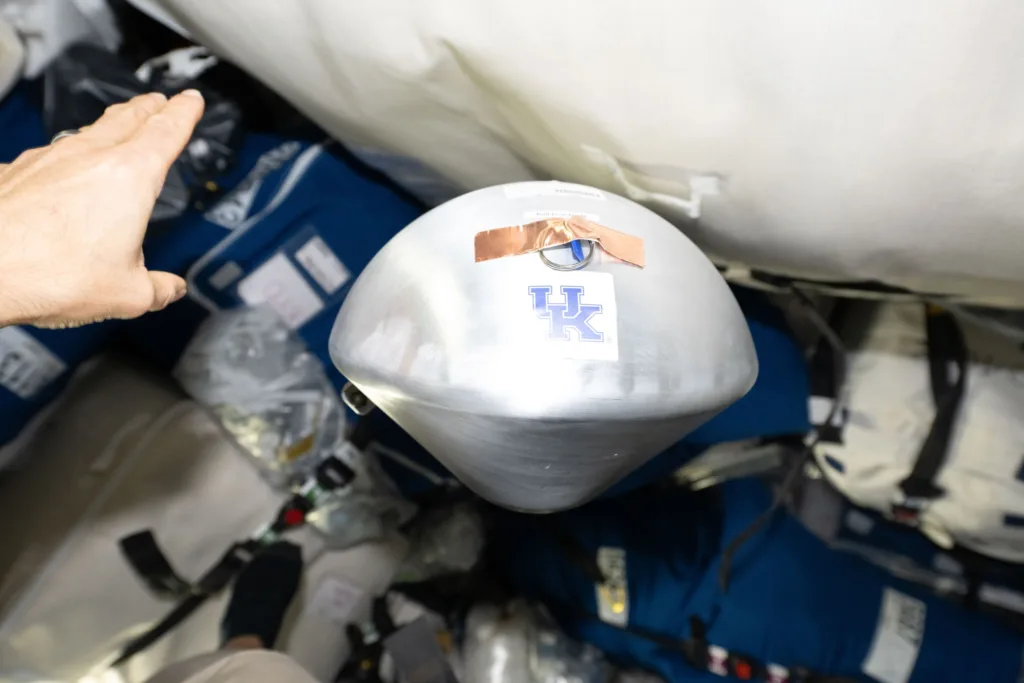
NASA is testing next-generation heat shield materials by packing them into 12 small experimental capsules aboard a departing cargo spacecraft filled with waste. The experiment, called the Kentucky Reentry Probe Experiment 3, launched inside a Northrop Grumman cargo spacecraft after it undocked from the International Space Station. Designed by University of Kentucky students and various partners, the capsules feature sensors to measure temperature, pressure, motion, magnetic field, and light as the vehicle breaks apart in Earth's atmosphere.
Satellite signals transmit live data back to researchers. The capsules test diverse materials and shapes, including traditional ceramic tiles, a 3-D printed heat shield, and flexible carbon-and-phenolic-fiber coverings called MERINO developed at NASA Ames. Other designs include a dual-cone shape, a Titan-landing aeroshell, and an umbrella-like deployable heat shield intended to slow down larger payloads.
The project offers an affordable way to gather flight data for future missions to the Moon and Mars while validating computer models.
WireUnWired turns the supplied report into a clearer brief, preserves the original publisher and author details, and adds relevant context without hiding where the information came from.
Relevant WireUnWired coverage is connected so one story can lead into the larger technology context.
Original publication: 9 October 2026 22:29
 NASA — Recently PublishedNASA Launches SSPICY Mission to Test Autonomous In-Space Inspection and Space Debris Reduction Technologies
 NASA — Recently PublishedNASA Tasks L3Harris Technologies With Building Final Test Telescope for the LISA Gravitational Wave Mission
 NASA — Recently PublishedNASA Hubble Data Solves Astronomical Cold Case With Discovery of Second-Generation Planet