
Moon-Like Madagascar
An astronaut aboard the International Space Station photographed the Saririaky anorthosite massif in southern Madagascar on August 28, 2026. Anorthosite is an intrusive igneous rock formed from magma cooling beneath the surface and is common on the Moon.
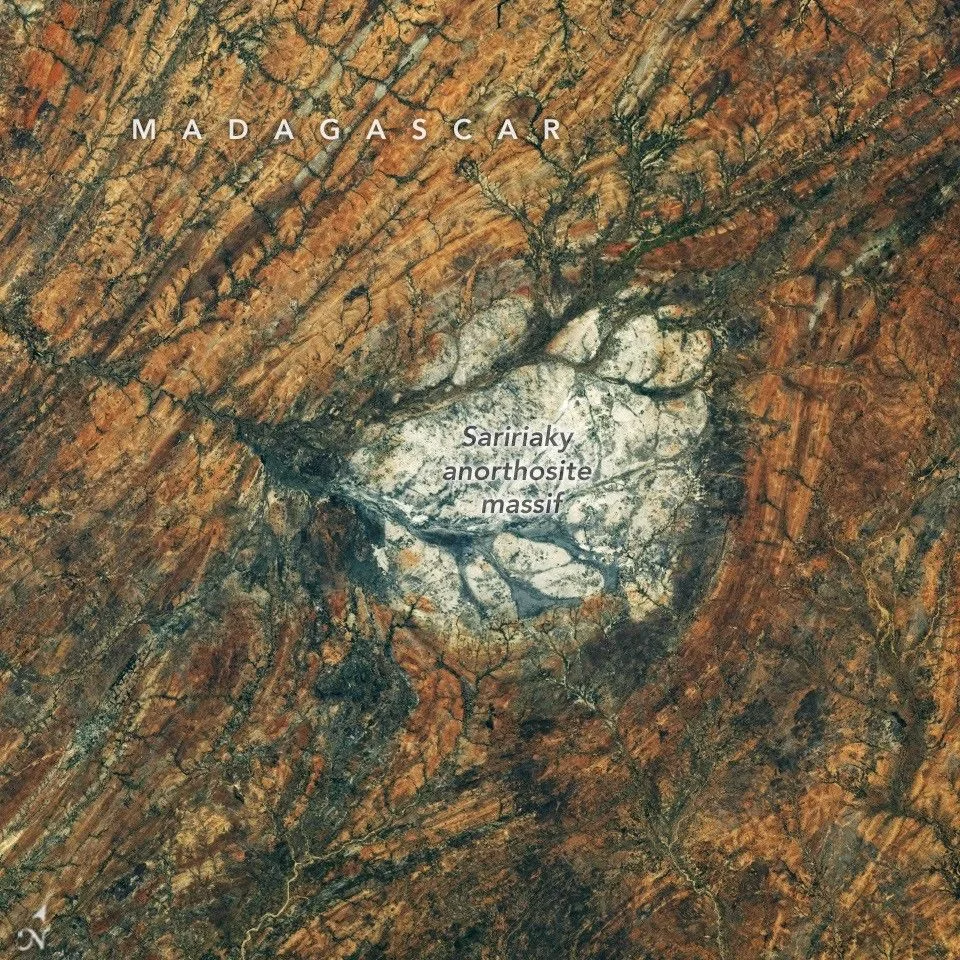
An astronaut aboard the International Space Station photographed the Saririaky anorthosite massif in southern Madagascar on August 28, 2026. Anorthosite is an intrusive igneous rock formed from magma cooling beneath the surface and is common on the Moon. Scientists estimate the Madagascar massif formed in the late Precambrian at least 600 million years ago, and its outcrop covers about 100 square kilometers, or 40 square miles.
The rock formation sits within a ductile shear zone, where high pressures and temperatures shaped it during the collision of landmasses to form the supercontinent Gondwana. Researchers study terrestrial anorthosites because limited lunar samples from Apollo missions require scientists to use Earth rocks as analogues for the Moon's crust.
The photograph, designated ISS075-E-85249, was captured using a Nikon Z9 digital camera by an Expedition 75 crew member.
Original publication: 5 October 2026 09:31
 NASA — Recently PublishedMapping the Gaps in NASA’s Return to the Moon, featuring Richard Spolzino
 NASA — Recently PublishedAPOD: 2026 October 1 – Harvest Moon with Erupting Mount Etna
 NASA — Recently PublishedNASA Selects Three New Scientific Investigations and Payload Suites to Support Future Moon Base Missions