How a Budget-Saving Russian Build Kickstarted the Space Station
When the first piece of the International Space Station launched in 1998, it carried a bargain price tag.
When the first piece of the International Space Station launched in 1998, it carried a bargain price tag. NASA paid a Russian firm two hundred twenty million dollars to build the Zarya module, cutting the estimated cost of an American alternative from Lockheed Martin in half. That financial shortcut created a forty-two thousand pound core roughly the size of a tour bus.
Zarya had to prove its worth immediately because engineers could not test its docking systems on the ground before flight. Our read suggests that this early reliance on cross-border manufacturing shaped the modular architecture of humanity's largest orbital outpost. The module provided two solar arrays for power and sixteen external tanks for fuel, acting as an anchor before human crews arrived.
Without Zarya serving as a stable hub in orbit, NASA's space shuttle Endeavour would have had nowhere to attach the U.S. Unity module two weeks later. Today, that solitary bus-sized component is mostly relegated to storage and receiving cargo ships. Yet it supports an orbiting complex now stretching the size of a football field.
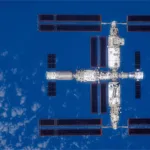
Watch how aging hardware handles the final decade of station operations as newer outposts like China's Tiangong station rise to challenge its legacy.
The story so far
Earlier coverage connected by shared names and topics. Follow the dates to see how coverage developed; these links do not imply every article describes the same event.
- Florida Students Get Live Call From NASA Astronauts on the International Space Station
On Tuesday, a classroom in St. Johns, Florida, will be replaced by a live feed from the International Space Station. Students will…
Connected by: InternationalEARLIER COVERAGE  Pakistan’s Astronaut to Become First International Visitor on China’s Tiangong Space Station
A Pakistani astronaut is set to launch on China’s Shenzhou 24 mission, becoming the first international visitor to the Tiangong space station.…
Connected by: InternationalEARLIER COVERAGE- Voyager 1 Crosses Light‑Day Milestone, Proving Human Ingenuity in Interstellar Space
At 2:16 a.m. PST on Nov. 18, 2026, Voyager 1 crossed a boundary no human‑made craft has crossed before: one light‑day from…
Connected by: SpaceEARLIER COVERAGE - China’s Long March 2F Launches Pakistan’s First Astronaut to Tiangong Space Station
China’s space station is about to welcome its first foreign astronaut, a Pakistani payload specialist who will spend a week aboard Tiangong…
Connected by: StationEARLIER COVERAGE - NOWHow a Budget-Saving Russian Build Kickstarted the Space StationCURRENT UPDATE
Original publication: 21 November 2026 02:49