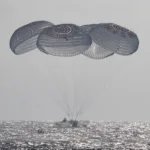
On October 12, 1964, the Soviet Union launched Voskhod 1, carrying the first multi-person crew into orbit.
On October 12, 1964, the Soviet Union launched Voskhod 1, sending the first crew of multiple people into orbit. Three Russian cosmonauts flew aboard the 24-hour mission.
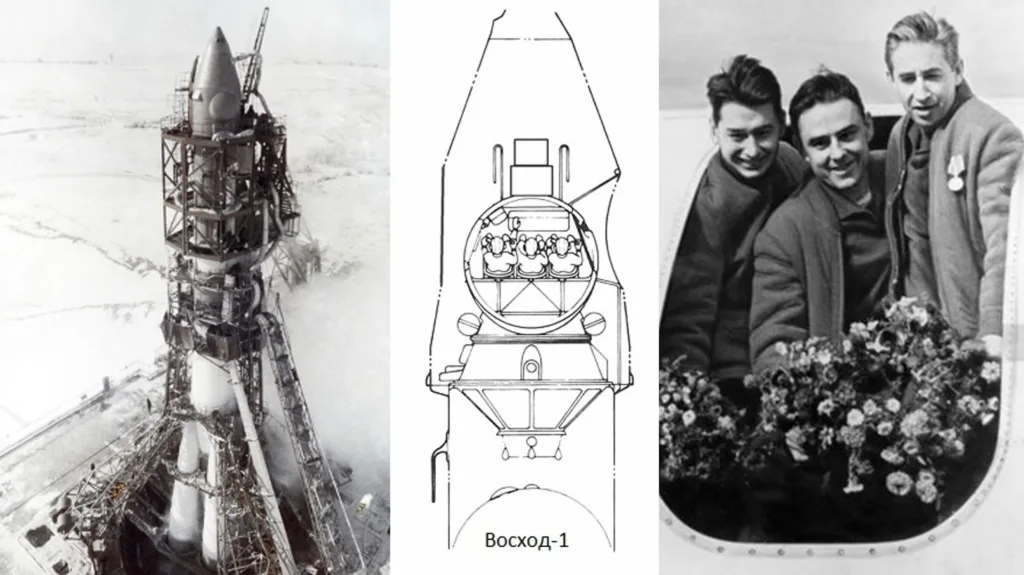
On October 12, 1964, the Soviet Union launched Voskhod 1, sending the first crew of multiple people into orbit. Three Russian cosmonauts flew aboard the 24-hour mission. The crew included commander Vladimir Komarov, engineer Konstantin Feoktistov, and doctor Boris Yegorov. Soviet politicians pressured the space program to add a third seat, leaving no room for spacesuits.
This made it the first spaceflight without spacesuits, and the first time civilians flew into space. Unlike earlier flights where crews parachuted out during descent, the cosmonauts stayed inside the spacecraft when it landed. The mission marked a major milestone in the space race against the United States, which had only flown single-person missions at the time.
Prompted by NASA's developing two-person Gemini program, Soviet leader Nikita Khrushchev ordered chief designer Sergei Korolev to convert the single-person Vostok spacecraft into a three-person vehicle. During the day-long flight, the crew photographed Earth and studied how liquids and gases behave in microgravity. NASA launched its first multi-crew mission, Gemini 3, about six months later in March 1965.
WireUnWired turns the supplied report into a clearer brief, preserves the original publisher and author details, and adds relevant context without hiding where the information came from.
Relevant WireUnWired coverage is connected so one story can lead into the larger technology context.
Original publication: 12 October 2026 19:59