NASA Just Dropped a Roadmap for the Next Decade of Flight. Here is What Sticks.
NASA traded quiet lab updates for a high-altitude spectacle this November, parachuting Administrator Jared Isaacman into the agency's inaugural MAX POWER expo at Kennedy Space Center.

NASA traded quiet lab updates for a high-altitude spectacle this November, parachuting Administrator Jared Isaacman into the agency's inaugural MAX POWER expo at Kennedy Space Center. The multi-day festival celebrated America's 250th anniversary by rolling out a heavy roster of hardware, from experimental aircraft to lunar lander test articles.
Yet beneath the air shows and presidential visits, the event delivered concrete deadlines for the agency's next decade of flight. Our read is that NASA is aggressively fusing public pageantry with private-sector partnerships to lock in its lunar timeline before political winds shift. Chief among the hardware debuts is the X-70 Fractal, an experimental aircraft unveiled by Isaacman to revolutionize crewed maneuverability.
While the source packet offers no specific flight-test metrics for the new X-plane, it sits alongside a $1 million student competition to design Moon Base technologies. Twelve companies also secured task orders to advance lunar infrastructure, including development of PROMISE, a nuclear-powered lunar rover. That nuclear power source is the mechanism required to keep rovers operating through frigid lunar nights where solar panels fail.
On the human spaceflight front, the agency opened astronaut applications through December 3 to staff upcoming Artemis and low Earth orbit missions.
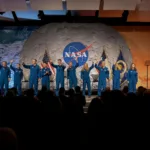
Meanwhile, the Artemis III crew took the stage to preview their 2027 low Earth orbit test flight aboard Orion, launched on the Space Launch System.
Those astronauts will test docking capabilities with lander test articles from Blue Origin and SpaceX, laying groundwork for a crewed lunar landing in 2028.
The limit here is that uncrewed test articles must still prove their rendezvous reliability in orbit before any boots touch the dust.
To cement these efforts, NASA announced that MAX POWER will evolve into a recurring annual event called CAPEWEEK, launching in March 2028 with an expected footprint of over 500,000 attendees.
Watch whether these commercial partnerships can deliver hardware fast enough to meet the 2028 landing window.
The story so far
Earlier coverage connected by shared names and topics. Follow the dates to see how coverage developed; these links do not imply every article describes the same event.
 How a Single NASA Mentor Shapes the Future of Space Flight
When Rice University student Malvika Bhardwaj asked her mentor if he had time to keep teaching interns amid a demanding workload, the…
Connected by: FlightEARLIER COVERAGE- NASA’s Max Power Expo Set to Showcase Moon Bases and Quiet Supersonic Flight
America’s newest aerospace expo arrives in Florida this November, bringing together quiet supersonic jets, autonomous vehicles, and deep space hardware on the…
Connected by: AdministratorEARLIER COVERAGE - NASA Chief Skydives Into Kennedy Space Center to Launch Public Air Show
NASA Administrator Jared Isaacman traded his office desk for a parachute, plummeting above 10,000 spectators to open the agency's MAX POWER air…
Connected by: AdministratorEARLIER COVERAGE - Personal Flight Meets Heavy Rockets at NASA
A Swedish startup just parked personal flight next to orbital heavy metal. At NASA's Kennedy Space Center, a compact rotorcraft known as…
Connected by: MAX POWEREARLIER COVERAGE - NOWNASA Just Dropped a Roadmap for the Next Decade of Flight. Here is What Sticks.CURRENT UPDATE




Original publication: 9 November 2026 21:37