NASA Invites the Public to Ride Along on Its Nuclear Rotorcraft Bound for Saturn's Moon Titan
Humanity is still far from traveling to the outer edges of the solar system in person, but your name can make the trip instead.
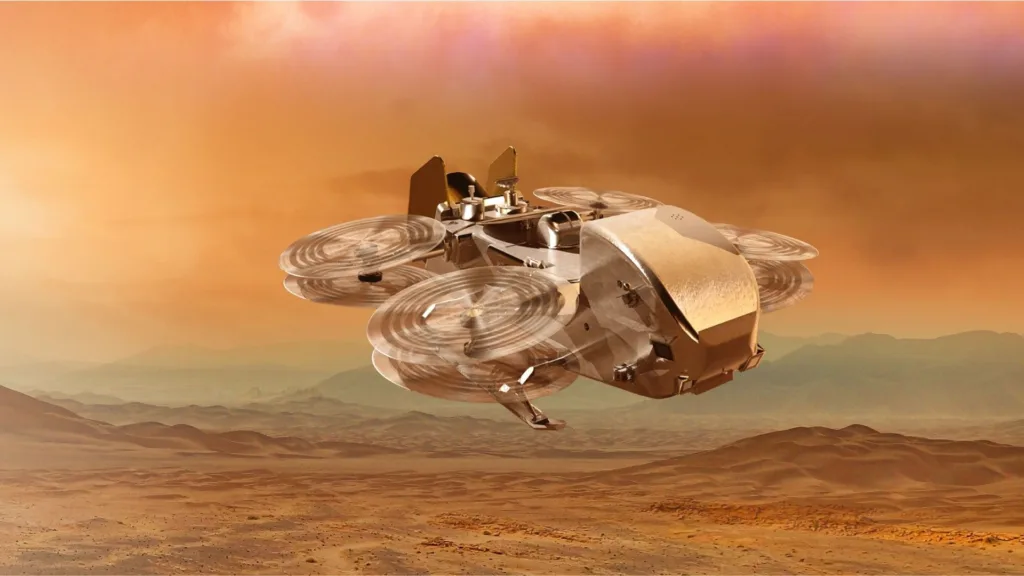
Humanity is still far from traveling to the outer edges of the solar system in person, but your name can make the trip instead. NASA has opened submissions for members of the public to include their names on a microchip aboard the upcoming Dragonfly spacecraft. The nuclear-powered rotorcraft, roughly the size of an SUV, is scheduled to launch toward Saturn's moon Titan in 2028.
Anyone wishing to participate must submit their name before January 15, 2027, ensuring a permanent spot on the vehicle as it undergoes assembly. This mission trades a stationary landing site for unprecedented mobility across an alien world. When Dragonfly arrives at Titan in 2034, it will operate for a planned duration of about three Earth years, flying between distant geological sites that feature organic material, liquid rivers, and thick atmospheres.
Unlike the historic Huygens probe, which operated for only a few hours after landing in 2005, Dragonfly will make frequent flights across dunes and the young Selk impact crater. NASA plans for the craft to hop locations roughly once every sixteen Earth days to analyze surface samples and search for chemical indicators of life.
Our read is that inviting millions of names onto a billion-mile voyage does more than build public enthusiasm for planetary science.
It creates a personal stake in a mission whose architecture relies on aerial exploration in an environment far more complex than any we have tested before.
As NASA looks beyond single-site landers to multi-destination aircraft like Dragonfly and prospective Mars rotorcraft concepts, these public participation campaigns anchor long-term deep-space ambitions in human curiosity.
Whether the craft uncovers the precursors to life or simply maps sweeping organic dunes, millions of Earthlings will effectively be along for the flight.
The story so far
Earlier coverage connected by shared names and topics. Follow the dates to see how coverage developed; these links do not imply every article describes the same event.
 When NASA First Tested the Giant That Built the Moon Program
Human spaceflight was merely six months old when NASA, an agency barely three years into its existence, attempted to launch a machine…
Connected by: SaturnEARLIER COVERAGE- Your Name Can Fly to Saturn's Moon Titan Aboard NASA's Dragonfly Rotorcraft
You will never soar above the organic sands or liquid methane lakes of Saturn’s largest moon, but your name can make the…
Connected by: RotorcraftEARLIER COVERAGE - NASA Invites the Public to Send Their Names to Saturn's Moon Titan
You may never step foot on the organic dunes of Saturn's largest moon, but your name can ride along on the spacecraft…
Connected by: NASA InvitesEARLIER COVERAGE - Northrop Grumman Resupply Mission to Test Cancer Drugs and Space Therapeutics
A Northrop Grumman cargo spacecraft will soon ride a rival's rocket into orbit, carrying experiments designed to fight cancer and muscle wasting…
Connected by: InvitesEARLIER COVERAGE - NOWNASA Invites the Public to Ride Along on Its Nuclear Rotorcraft Bound for Saturn's Moon TitanCURRENT UPDATE




Original publication: 7 November 2026 20:30