NASA Is Testing Space Strawberries and Cucumbers to Beat Deep-Space Menu Fatigue
Astronauts traveling to the Moon and Mars will face months of packaged rations, making menu variety a critical frontier for long-duration spaceflight.
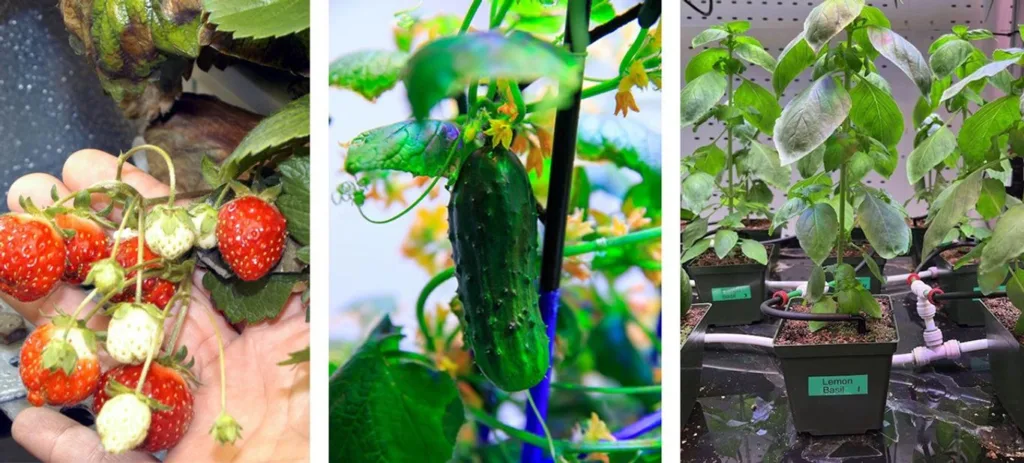
Astronauts traveling to the Moon and Mars will face months of packaged rations, making menu variety a critical frontier for long-duration spaceflight. To solve this, researchers are testing crops like strawberries, cucumbers, and lemon basil inside controlled environment chambers to supply fresh nutrition far from Earth. These plants do more than feed the crew because they actively absorb carbon dioxide, produce oxygen, and recycle water during flight.
Strawberries offer a rare sweet option for deep-space menus since they are nutritious, aromatic, and self-pollinating. Researchers at the Kennedy Space Center tested a wild strawberry against NASA’s leading candidate, a variety called Delizz, under simulated space conditions. While the wild competitor produced twice as many buds, flowers, and fruit from a seed, it generated too many runners that would consume valuable spacecraft room.
Delizz kept its top spot by producing large, red fruit without overcrowding the limited space. Cucumbers could soon become the first members of the gourd family to join the space menu. NASA-funded researchers evaluated these plants under simulated spaceflight conditions and found they produced a steady stream of edible fruit despite showing enlarged leaves.
Adding crops like cucumbers increases plant biodiversity, which improves the likelihood of overall crop success during extended missions far from home.
Our read: choosing compact, high-yield crops like Delizz strawberries and space-tested cucumbers reveals a strict engineering trade-off where spatial efficiency trumps sheer raw output.
Lemon basil also cleared preliminary testing and seed sanitization to fight menu fatigue by transforming bland packaged meals into satisfying food.
A new prototype growth chamber launching to the International Space Station will soon test these systems for future Moon Base habitats.
Sources & updates
AI-assisted brief based on the original reporting.
Original report: NASA — Recently Published
Source published: 25 Nov 2026, 23:23
Image credit: NASA — Recently Published
The story so far
Earlier coverage connected by shared names and topics. Follow the dates to see how coverage developed; these links do not imply every article describes the same event.
 New NASA Documentary Reveals the Hardest Parts of Building Europa Clipper
Building a spacecraft capable of surviving the severe radiation fields around Jupiter requires more than clever engineering. It demands surviving a global…
Connected by: SpaceEARLIER COVERAGE- NASA Wants a Lunar Nuclear Reactor by 2030 to Beat the Two-Week Night
Solar panels cannot survive a lunar night that lasts two weeks. To keep habitats and rovers running when the sun goes down,…
Connected by: EarthEARLIER COVERAGE - Dragonfly’s New Cameras Set to Reveal Titan’s Hidden Secrets
NASA’s Dragonfly rotorcraft is getting its eyes on Titan. Seven high‑resolution cameras, built by Malin Space Science Systems, have been installed in…
Connected by: SpaceEARLIER COVERAGE - NASA’s High‑Tech Eyes on Iowa Explosive Detonation
NASA’s P‑3 Orion, Gulfstream III, and B200 aircraft are circling the Iowa Army Ammunition Plant as the U.S. Army prepares to detonate…
Connected by: NASAEARLIER COVERAGE - NOWNASA Is Testing Space Strawberries and Cucumbers to Beat Deep-Space Menu FatigueCURRENT UPDATE


Original publication: 25 November 2026 23:23