Europe's Hera Probe Reveals the Aftermath of Humanity's First Asteroid Impact
Four years after NASA crashed a spacecraft into a distant space rock, a new set of eyes has finally arrived at the scene.
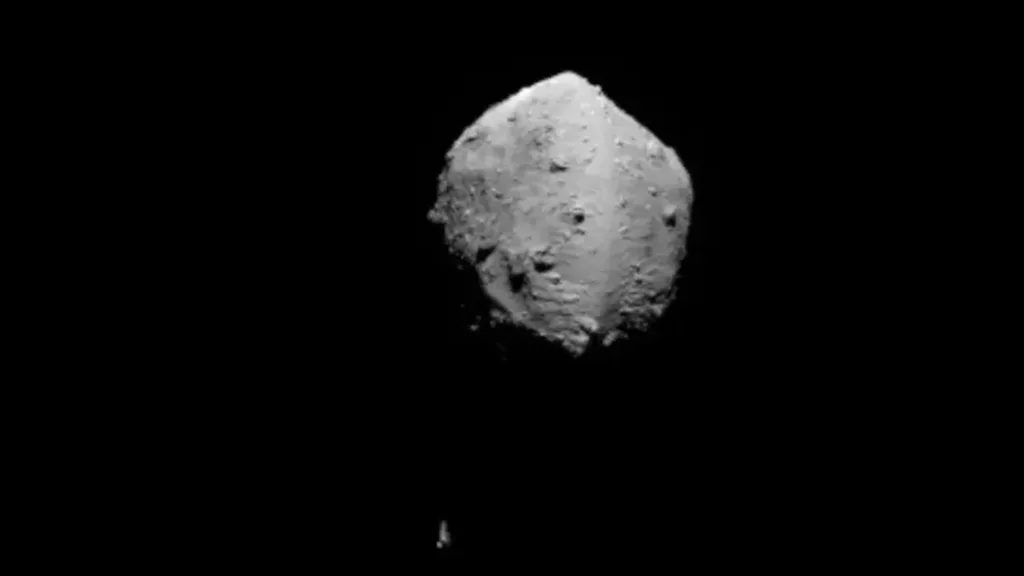
Four years after NASA crashed a spacecraft into a distant space rock, a new set of eyes has finally arrived at the scene. The European Space Agency's Hera probe captured its first detailed look at the Didymos binary asteroid system, revealing a landscape transformed by humanity's first planetary defense test.
Principal Investigator Patrick Michel said the initial team reaction was simply one of awe upon seeing the new perspective of the primary asteroid. This particular view shows the opposite side of the main body from what the DART impactor saw right before collision. That historic 2022 collision deliberately struck Dimorphos, a small moonlet orbiting the larger 780-meter Didymos rock.
The forceful nudge successfully altered the moonlet's orbit by shortening its lap around the main body by roughly 33 minutes. While a speed reduction of just fractions of an inch per second sounds minor, our read is that this tiny margin proves kinetic deflection can work as a viable planetary shield, provided humanity detects incoming threats early enough.
Yet the aftermath holds complex puzzles for researchers examining Hera's latest telemetry.
While the main asteroid retains its familiar equatorial ridge, scientists spotted new craters, varied grooves, and scattered boulders across the surface.
Mission scientist Michael Kueppers noted that debris likely traveled across the gap between the two bodies, meaning much of this surface reshaping comes from the impact fallout itself.
Watch for upcoming mission data as researchers map these structural shifts to understand exactly how binary systems react to sudden, violent disruption.
The story so far
Earlier coverage connected by shared names and topics. Follow the dates to see how coverage developed; these links do not imply every article describes the same event.
 When Galileo First Traded Jupiter For A Quick Look At An Asteroid
Humanity had never seen an asteroid up close until a Jupiter-bound probe broke through the cosmic unknown in October 1991. The Galileo…
Connected by: HumanityEARLIER COVERAGE- Jessica Watkins Makes History as First Black Woman to Command a Space Mission
When the Falcon 9 rocket roared on Oct. 1, the world watched a new kind of commander take the helm. Jessica Watkins,…
Connected by: SpaceEARLIER COVERAGE - Voyager 1’s 48‑Hour Vanishing Act Reveals Self‑Repair in Interstellar Space
Voyager 1, humanity’s farthest spacecraft, slipped into silence for 48 hours last month before re‑establishing contact. The probe, already a light‑day away,…
Connected by: SpaceEARLIER COVERAGE - Galileo’s Final Dance: A Dying Probe’s Last Flyby of Jupiter’s Red Moon
On Nov. 2002, NASA’s Galileo was a ghost ship, its fuel tanks nearly empty, yet it still had one more swing by…
Connected by: ProbeEARLIER COVERAGE - NOWEurope's Hera Probe Reveals the Aftermath of Humanity's First Asteroid ImpactCURRENT UPDATE

Original publication: 6 November 2026 20:30