
Hera Uncovers DART’s Cosmic Mess: A Stadium‑Sized Crater and Tumbling Asteroid
NASA’s DART probe slammed into Dimorphos, delivering 10 billion joules of energy at more than 13,700 mph (6.14 km/s). The impact carved a crater the size of a stadium—about 500 feet (151 m) across—nearly half the asteroid’s diameter.
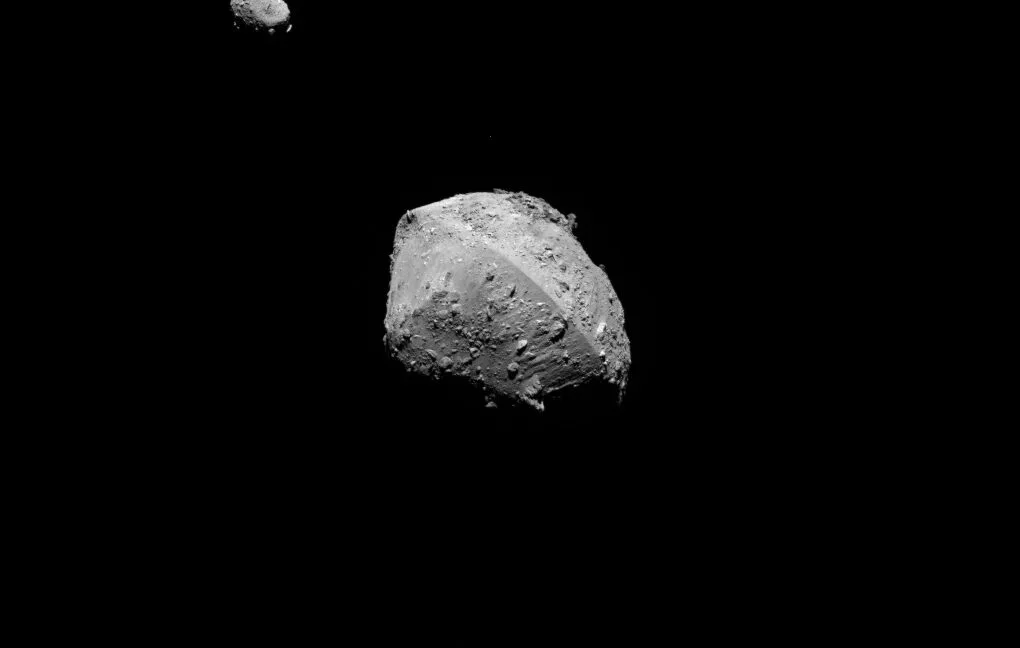
NASA’s DART probe slammed into Dimorphos, delivering 10 billion joules of energy at more than 13,700 mph (6.14 km/s). The impact carved a crater the size of a stadium—about 500 feet (151 m) across—nearly half the asteroid’s diameter. Astronomers measured Dimorphos’s 12‑hour orbit shortened by 33 minutes, 25 times the most conservative expectation.
Only a distant telescope and a brief CubeSat flash captured the event, leaving many details hidden. Scientists had predicted either a crater or a reshaped body, but Hera’s first images show something more chaotic. The crater is so large that Dimorphos’s shape has changed, and the asteroid now tumbles wildly in its orbit.
Hera also spotted a swarm of boulders surrounding the pair, a debris field far larger than the initial Hubble snapshot. The extent of the mess raises questions about how debris will behave in future deflection attempts. Over the next several months, Hera will fly closer to Didymos and Dimorphos and deploy two small sub‑satellites.
These landers will collect data on composition, internal structure, and mass, key to reconstructing DART’s impact dynamics.
The measurements will anchor computer models that predict how different asteroids respond to kinetic‑impact deflection.
However, the findings apply to this specific system, and generalizing to all near‑Earth asteroids remains uncertain.
Our read: the chaotic aftermath of DART shows that a single impact can create a massive crater, alter shape, and launch a debris swarm.
Understanding how such debris moves and how tumbling affects future missions is essential for planetary defense.
The data from Hera will help engineers design deflection strategies that account for chaotic outcomes.
As we plan next‑generation missions, we should watch how debris behavior shapes the feasibility of kinetic‑impact techniques.
Sources & updates
AI-assisted brief based on the original reporting.
Original report: Ars Technica
Source published: 26 Nov 2026, 04:06
Image credit: Ars Technica
The story so far
Earlier coverage connected by shared names and topics. Follow the dates to see how coverage developed; these links do not imply every article describes the same event.
 Hubble Maps Cosmic Lenses to Prime Roman Telescope for Dark Matter Hunt
Massive foreground galaxies bend and warp background light into striking cosmic mirrors, creating natural magnifying glasses known as gravitational lenses. NASA's Hubble…
Connected by: CosmicEARLIER COVERAGE- A Spacecraft Caught One Asteroid Eclipsing Another 121 Million Miles Away
A spacecraft speeding through the void just beamed home a rare sight: one asteroid casting its shadow on another. The European Space…
Connected by: ScientistsEARLIER COVERAGE - Hera Arrives at Dimorphos to Inspect Humanity's First Asteroid Crash Site
Humanity's first planetary defense test left a deep scar on a distant space rock, and now a new spacecraft has arrived to…
Connected by: DimorphosEARLIER COVERAGE - Hera Uncovers Stadium‑Sized Crater on Dimorphos, Proving DART’s Asteroid Deflection
A stadium‑sized crater now marks the face of Dimorphos, the moonlet of asteroid Didymos, after NASA’s DART spacecraft slammed into it on…
Connected by: Sized CraterEARLIER COVERAGE - NOWHera Uncovers DART’s Cosmic Mess: A Stadium‑Sized Crater and Tumbling AsteroidCURRENT UPDATE
Original publication: 26 November 2026 04:06