A Spacecraft Caught One Asteroid Eclipsing Another 121 Million Miles Away
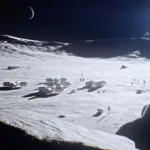
A spacecraft speeding through the void just beamed home a rare sight: one asteroid casting its shadow on another.
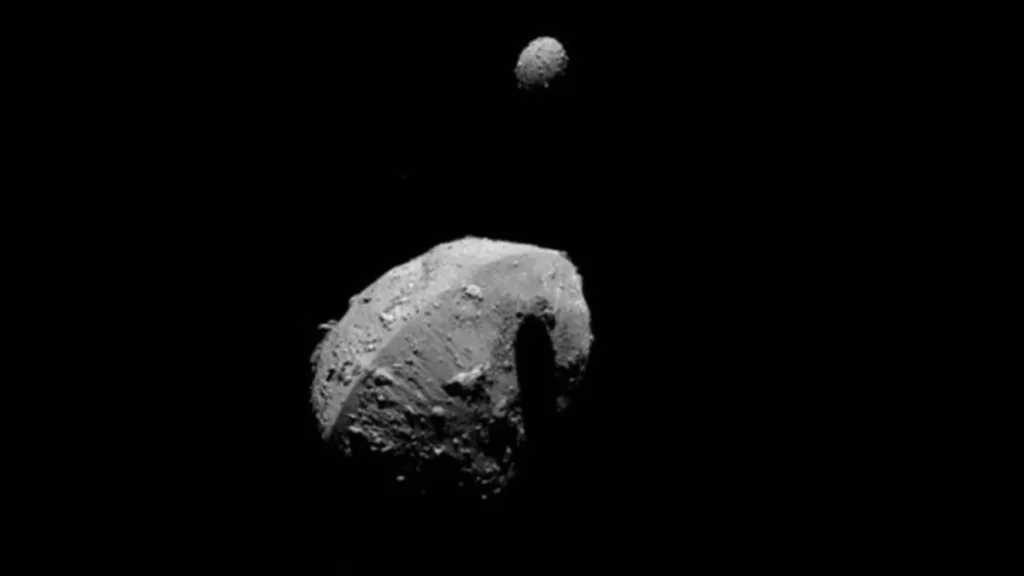
A spacecraft speeding through the void just beamed home a rare sight: one asteroid casting its shadow on another. The European Space Agency probe captured the eclipse within the Didymos double asteroid system, showing the smaller moonlet Dimorphos blocking the sun for the larger body. This snapshot arrived as the probe approaches the system from a distance of 121 million miles away.
That long-range view resolves individual boulders scattered across the surface. Scientists describe the bodies as rubble piles held together only by weak gravity rather than solid rock. Our read suggests that capturing such sharp shadow details from deep space proves how far optical navigation has advanced for intercept missions.
The probe will arrive at the system to inspect the aftermath of a previous NASA kinetic impact test designed to alter asteroid trajectories. Watch for the full image release when the mission reaches its destination.
Sources & updates
AI-assisted brief based on the original reporting.
Original report: Space.com
Source published: 24 Nov 2026, 20:30
Image credit: Space.com
The story so far
Earlier coverage connected by shared names and topics. Follow the dates to see how coverage developed; these links do not imply every article describes the same event.
 A European Space Agency Satellite Just Played Doom in Orbit
A tiny satellite in low-Earth orbit recently fired up a 1993 first-person shooter entirely by voice command. Playing video games was never…
Connected by: EuropeanEARLIER COVERAGE- How a Glitched Spacecraft Pulled Off History's First Asteroid Liftoff
A crippled spacecraft achieved the impossible on November 19, 2005, by executing the first-ever liftoff from an asteroid. Japan's Hayabusa probe was…
Connected by: SpacecraftEARLIER COVERAGE - Scientists Call for a Lunar Moratorium to Prevent a Space Gold Rush
Researchers are sounding the alarm over plans to industrialize the moon before global regulations can catch up. Both the U.S. and China…
Connected by: ScientistsEARLIER COVERAGE - Northrop Grumman Secures $290 Million Contract for Next-Gen Weather Satellites
A single federal contract spans nearly two decades to overhaul how meteorologists track the atmosphere. NASA awarded Northrop Grumman Systems Corporation a…
Connected by: MillionEARLIER COVERAGE - NOWA Spacecraft Caught One Asteroid Eclipsing Another 121 Million Miles AwayCURRENT UPDATE
Original publication: 24 November 2026 20:30