
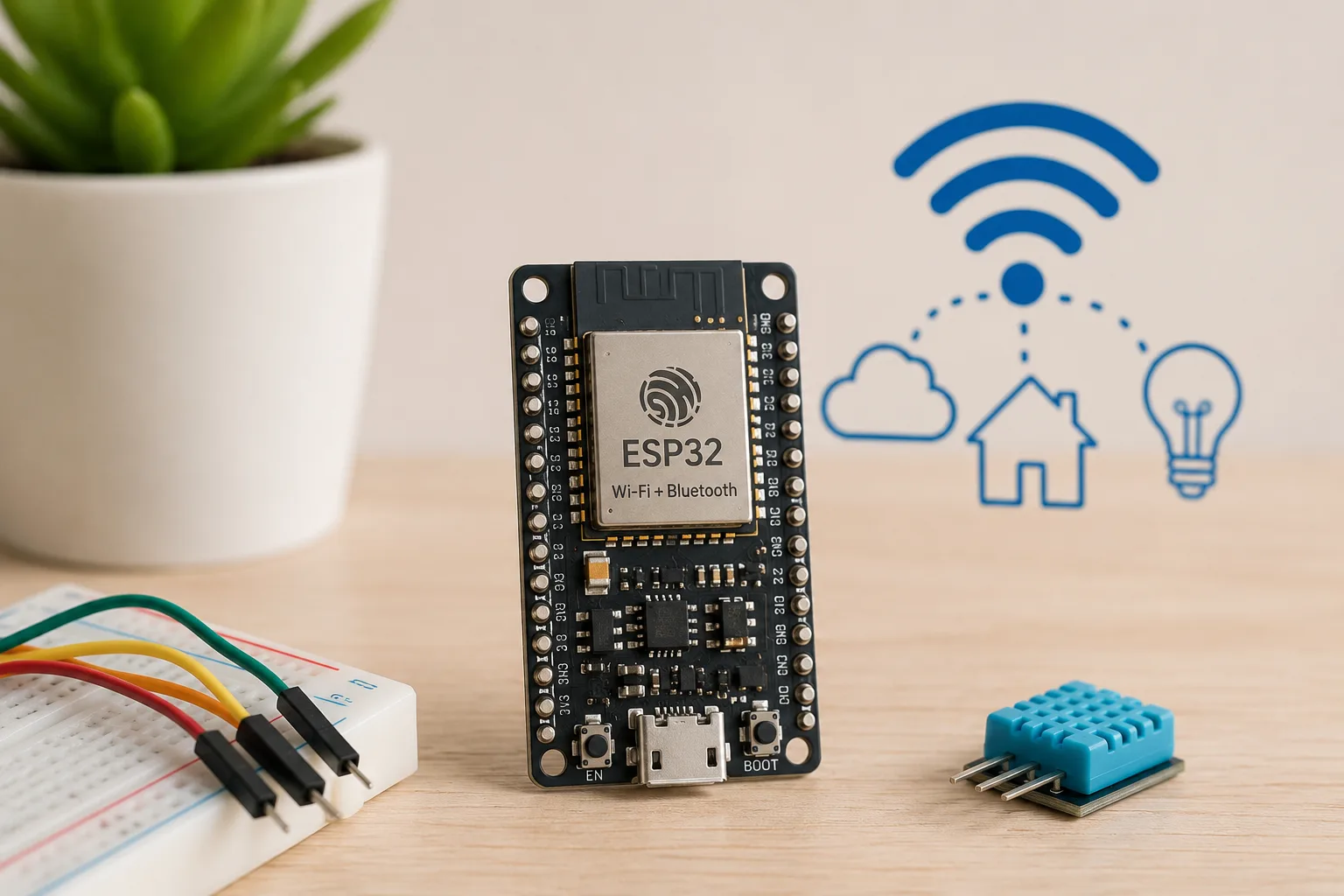

If you have ever dabbled in DIY electronics, you probably started with an Arduino. For years, the Arduino Uno was the undisputed king of makers: a simple, reliable little board that could blink LED lights, read temperature sensors, and spin motors.
But it had one massive flaw: it was completely isolated.
Out of the box, a standard Arduino is blind and deaf to the internet. To connect it to Wi-Fi, you had to buy bulky add-on boards called “shields,” write complex routing code, and spend more money on the upgrades than you did on the original board.
Then came the ESP32, and overnight, the rules of hardware changed forever.
The ESP32
Created by Shanghai-based Espressif Systems, the ESP32 is a microcontroller—a tiny, self-contained computer on a single microchip. But unlike its predecessors, the ESP32 was built from the ground up with both Wi-Fi and Bluetooth integrated directly into the silicon.
Best of all? A fully assembled ESP32 development board costs roughly $5. It effectively took the barrier to entry for building connected “smart” devices and shattered it to pieces.
Why ESP32 is a Beast Under the Hood ?
To understand why engineers and hobbyists obsess over this little chip, you only need to look at three key upgrades:
Two Brains Are Better Than One: Most basic microcontrollers have a single-core processor, meaning they can only do one task at a time. The ESP32 is dual-core. In plain English, this means one “brain” can be dedicated entirely to maintaining a stable Wi-Fi connection, while the second brain reads sensors, runs logic, and controls motors without ever slowing down.
Wireless Flexibility: It doesn’t just do Wi-Fi. It also supports Bluetooth Low Energy (BLE), the exact same power-sipping technology your smartwatch uses to talk to your phone.
Smart Pins: The metal pins on the ESP32 do more than just send power. Several of them feature built-in capacitive touch sensors. This means you can attach a simple copper wire to a pin, and the chip can detect when a human finger touches it—allowing you to create hidden touch-sensitive buttons through wood or plastic without mechanical switches.
What Can You Actually Build With It?
Because it is compatible with the exact same programming language used by Arduino (as well as Python), the ESP32 is the engine behind countless modern DIY projects:
Smart Plant Monitors: Sensors measure soil moisture and sunlight, and the ESP32 automatically texts your phone or pings your Discord server when your fern needs water.
Live Data Tickers: Pulling real-time weather forecasts, stock prices, or transit schedules from the internet and displaying them on low-power e-paper screens.
0" data-index-in-node="0">Live Data Tickers: Pulling real-time weather forecasts, stock prices, or transit schedules from the internet and displaying them on low-power e-paper screens.
The Catch: What to Watch Out For
No piece of tech is perfect. If you are switching to the ESP32, keep two design hurdles in mind:
It Thirsts for Power: Keeping a Wi-Fi radio active drains batteries fast. To make battery-powered gadgets last, you have to learn how to put the chip into “Deep Sleep” mode—a feature where it shuts down its Wi-Fi radio and goes dormant until a timer or sensor wakes it up.
The ESP32 did for hardware what open-source software did for coding. By packing Wi-Fi, Bluetooth, and dual-core processing into a chip cheaper than a fast-food meal, it transformed the Internet of Things from a corporate playground into a canvas for anyone with an idea.
e VerdictThe ESP32 did for hardware what open-source software did for coding. By packing Wi-Fi, Bluetooth, and dual-core processing into a chip cheaper than a fast-food meal, it transformed the Internet of Things from a corporate playground into a canvas for anyone with an idea.
Would you like me to adapt this piece into a specific format next, such as a weekly newsletter email or a website blog post with SEO metadata?
Discover more from WireUnwired Research
Subscribe to get the latest posts sent to your email.