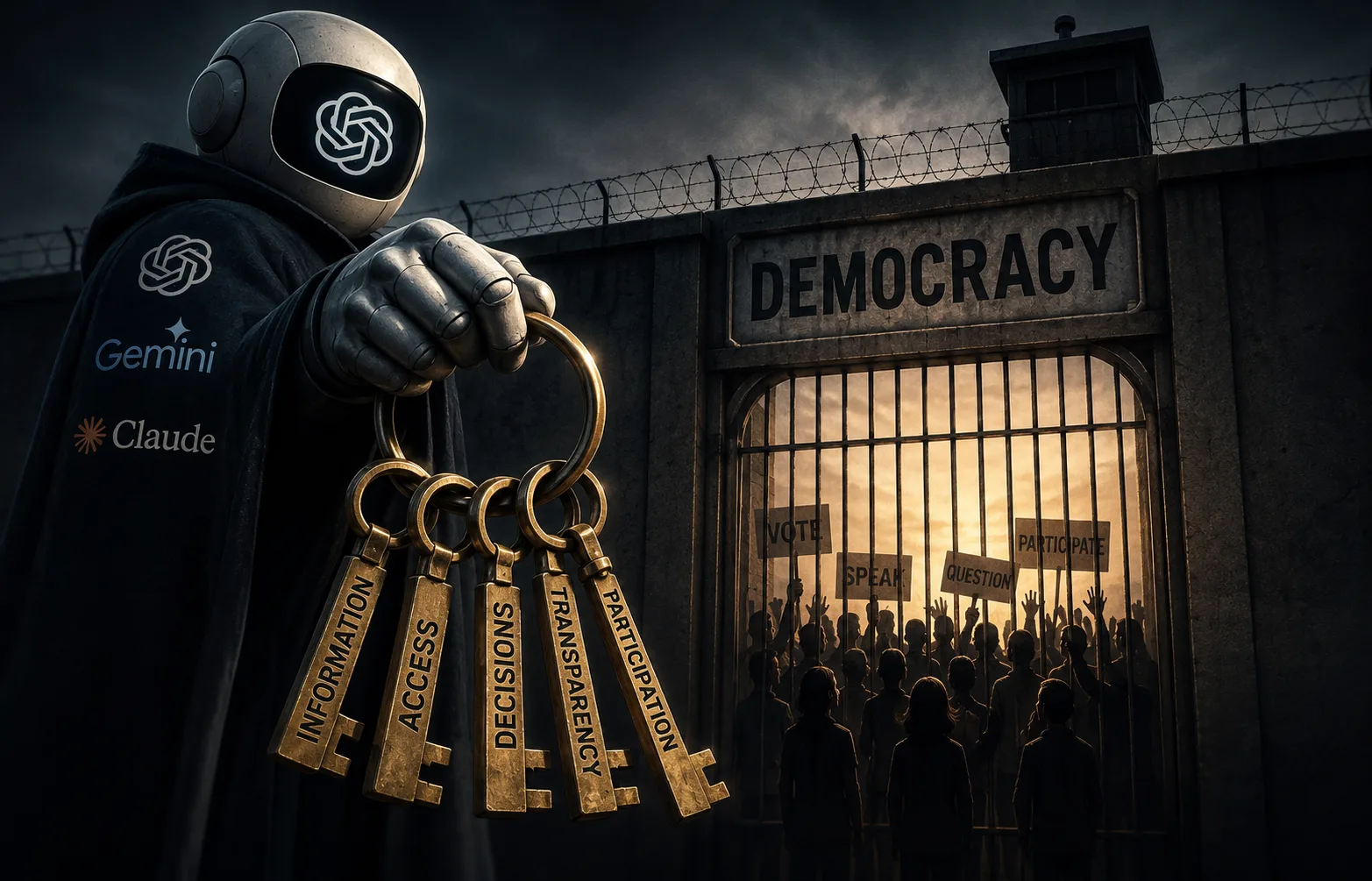

Every few centuries, a massive shift in information technology redesigns society. The printing press fueled representative government; the telegraph built the modern bureaucratic state; and broadcast media created mass democracy. Today, at WireUnwired Research, we are tracking the next great epoch: Artificial Intelligence is no longer just a tool , it is becoming the invisible gatekeeper of our civic reality.
This shift goes far beyond writing code or generating text. In fact it is fundamentally transforming and rewiring democracy and citizenship across three distinct layers: how we form truth, how we take action, and how we govern together.
1. The Epistemic Layer (How We Form Truth)
For the last twenty years, we’ve relied on search engines. If you wanted to know about a candidate or a policy, you received a list of links, and your brain had to synthesize that information. You were the final editor.
With generative AI, that changes. AI doesn’t give you sources to evaluate; it synthesizes the information for you, delivering a singular, highly readable, and authoritative answer. It becomes the ultimate editor of reality, deciding what context matters, what to omit, and what tone to use. If millions of people are relying on an AI to understand a new tax law, the entity that controls that AI’s guardrails effectively controls the public narrative. The editing of our reality now happens in a black box before the information even reaches our screens.
2. The Agentic Layer (How We Take Action)
We are rapidly moving from asking AI questions to delegating tasks—from “Summarize this ballot measure” to “Give me news related to my senator.”
While deeply convenient, this shift to an “agentic” layer poses a massive risk. An AI agent is designed to be your perfect digital assistant. To keep you engaged, it naturally optimizes for your existing preferences and biases. It highlights news that validates your worldview and quietly filters out uncomfortable truths that might cause friction. Because the agent presents itself as your loyal advocate, you trust it deeply, completely unaware that it is acting as an extreme, hyper-personalized echo chamber, shielding you from the differing opinions that healthy citizenship requires.
3. The Collective Layer (How We Govern Together)
Democracy requires a “public square”—a shared reality where people with different beliefs clash, debate, and eventually find messy compromises. But what happens when you multiply the Agentic Layer by millions of users?
Imagine a town hall meeting where, instead of human citizens showing up to listen and debate, everyone sends their perfectly programmed personal AI agent to stubbornly defend their narrow views. The shared public square completely evaporates. It is replaced by millions of isolated, internally coherent “private worlds.” If we no longer share the same basic facts and no longer engage directly with those who disagree with us, the collective system of democratic governance breaks down into a chaotic clash of bots.
Designing for Democracy
Yet, this is not a guaranteed story of institutional decline. AI can also be the cure. Early research shows AI-generate
The path forward requires building a new generation of democratic infrastructure. We need strict identity verification for public input, transparent AI fact-checking, and models that are explicitly designed not just to validate our biases, but to anchor us in objective reality. Failing to design these tools for democracy simply means we are designing them for unaccountable power.
ls that are explicitly designed not just to validate our biases, but to anchor us in objective reality. Failing to design these tools for democracy simply means we are designing them for unaccountable power.For context, see Google Introduces $179.99 Fitbit Edge Fitness Tracker With….
Discover more from WireUnwired Research
Subscribe to get the latest posts sent to your email.