When the World's Largest Radio Telescope Crumbled Under Its Own Weight
On a clear November night in 1988, the world's largest radio telescope collapsed into a massive pile of twisted wreckage without a single gust of wind to blame.
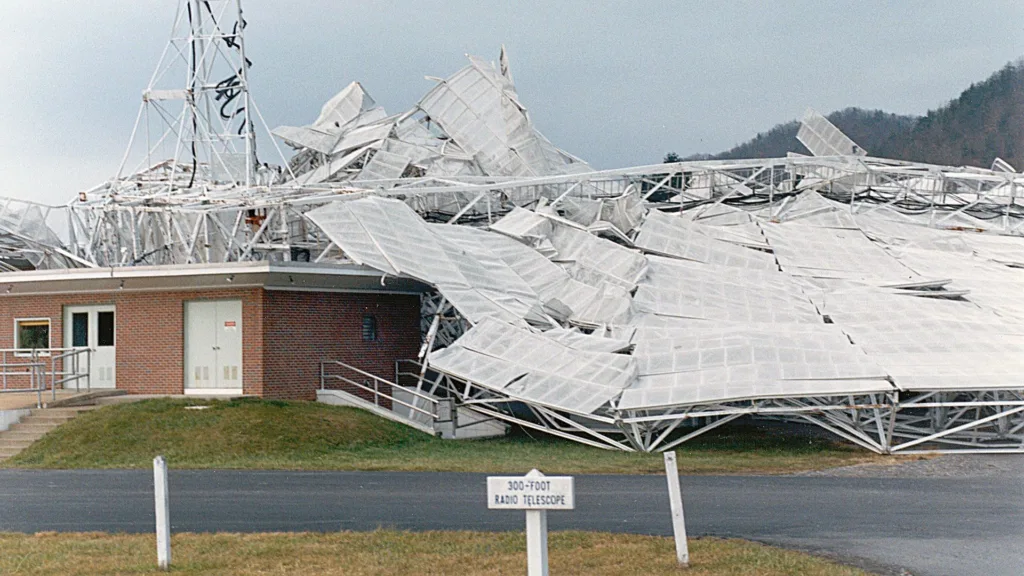
On a clear November night in 1988, the world's largest radio telescope collapsed into a massive pile of twisted wreckage without a single gust of wind to blame. The 300-foot instrument in Green Bank, West Virginia simply gave way to its own mass at 9:46 p.m., leaving morning staff staring at an unexpected disaster.
Investigators later traced the failure to a single steel connector plate that cracked under unforeseeable stress factors. That critical component, known as a gusset plate, was one of four holding the telescope's massive metal beams together. According to the National Radio Astronomy Observatory, these plates were never built to endure the 26 years the structure operated.
The rapid two-year construction timeline from its debut meant the facility required heavy upgrades over the decades, including a finer-meshed aluminum surface added in 1970 to combat warping from snow and maintenance. Our read suggests that the very speed and ambition defining early radio astronomy planted the seeds for its structural limits.
Despite its untimely end, the instrument yielded an all-sky survey that served as the catalog for nearly every northern hemisphere radio object studied elsewhere.
Three years after the disaster, construction began on a replacement that eventually launched science operations in 2001.
The story so far
Earlier coverage connected by shared names and topics. Follow the dates to see how coverage developed; these links do not imply every article describes the same event.
 Hawaii Students Spend Four Days Exploring the Universe Beneath the Milky Way
More than 1,400 students on the Big Island of Hawaii traded standard classrooms for the Milky Way during a four-day astronomy outreach…
Connected by: ObservatoryEARLIER COVERAGE- Could James Webb's Little Red Dots Be Big Bang Remnants?
NASA's James Webb Space Telescope keeps finding compact cosmic objects that vanish before the universe reaches two billion years old. Researchers now…
Connected by: TelescopeEARLIER COVERAGE - Hubble’s Star‑Cluster Snapshot Suggests a Captured Ancient Relic
Hubble’s latest image of Messier 30 (M30) shows a glittering sea of stars, some dating back 11.5 to 13.5 billion years—just shy of…
Connected by: TelescopeEARLIER COVERAGE - JWST Uncovers Earliest Pair of Supermassive Black Hole Quasars, Defying Cosmic Dawn Models
A pair of black holes so massive and so close, seen just 900 million years after the Big Bang, has left astronomers scrambling.…
Connected by: TelescopeEARLIER COVERAGE - NOWWhen the World's Largest Radio Telescope Crumbled Under Its Own WeightCURRENT UPDATE




Original publication: 15 November 2026 21:04