Hubble’s Star‑Cluster Snapshot Suggests a Captured Ancient Relic
Hubble’s latest image of Messier 30 (M30) shows a glittering sea of stars, some dating back 11.5 to 13.5 billion years—just shy of the universe’s 13.8‑billion‑year age.
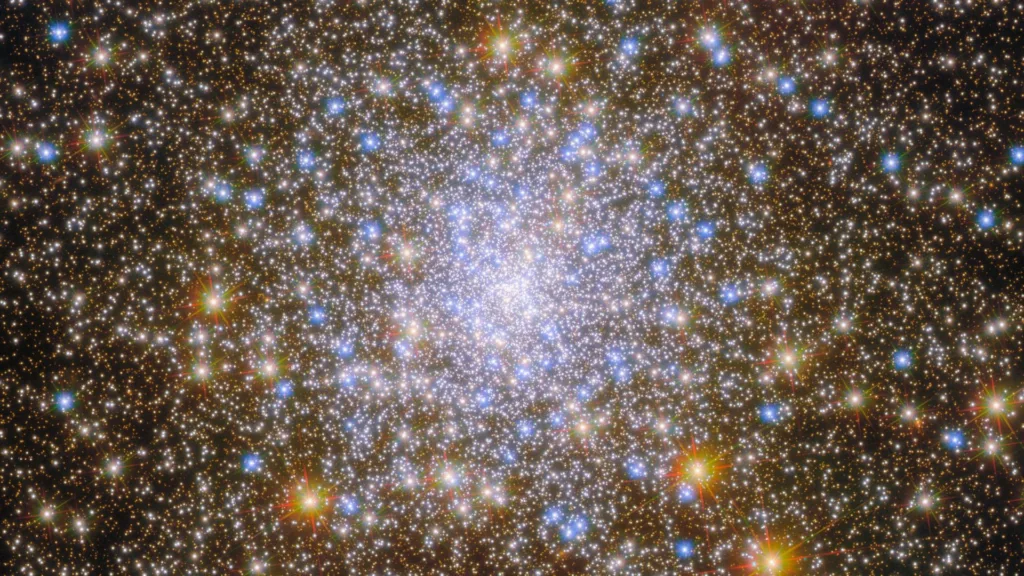
Hubble’s latest image of Messier 30 (M30) shows a glittering sea of stars, some dating back 11.5 to 13.5 billion years—just shy of the universe’s 13.8‑billion‑year age. The cluster sits 27,500 light‑years away in Capricornus, a densely packed, roughly spherical group that holds tens of thousands of stars.
Globular clusters are cosmic time capsules. Their ancient stars preserve the chemical fingerprints of the gas that birthed them, letting astronomers reconstruct the Milky Way’s earliest conditions. Because M30’s stars are almost as old as the cosmos, they carry a snapshot of the galaxy’s infancy.
What makes M30 especially intriguing is its motion. The cluster orbits the Milky Way in the opposite direction to the galaxy’s rotation—a retrograde path that suggests it may have been captured from outside our galaxy billions of years ago. If true, M30 would be a relic of a past galactic merger.
The capture hypothesis isn’t proven; more data are needed to confirm M30’s origin.
Still, the cluster’s age and unusual orbit make it a prime target for studies that could illuminate how the Milky Way assembled its stellar halo.
The story so far
Earlier coverage connected by shared names and topics. Follow the dates to see how coverage developed; these links do not imply every article describes the same event.
 A Retired Telescope Catches the Universe in Its Aluminum Eye
A massive aluminum dish once tuned to the hidden whispers of the cosmos now does something far simpler, catching the stars in…
Connected by: TelescopeEARLIER COVERAGE- Hubble and Webb Capture the Ghostly Cat's Head Nebula in New Halloween Views
A glowing red eye peers out from a massive cloud of cosmic dust, looking right at home in a witch's cauldron. Released…
Connected by: TelescopeEARLIER COVERAGE - Could James Webb's Little Red Dots Be Big Bang Remnants?
NASA's James Webb Space Telescope keeps finding compact cosmic objects that vanish before the universe reaches two billion years old. Researchers now…
Connected by: TelescopeEARLIER COVERAGE - Curiosity Spots Strange Disk Crystals on Mars
NASA's Curiosity rover is staring down a patch of Martian ground littered with disk-shaped crystal forms. The rover snapped the close-up view…
Connected by: SpaceEARLIER COVERAGE - NOWHubble’s Star‑Cluster Snapshot Suggests a Captured Ancient RelicCURRENT UPDATE




Original publication: 11 November 2026 20:30