Philae’s Bumpy Landing: A Harpoon Failure That Turned a Comet Mission Into a Tale of Resilience
When Philae first touched down on Comet 67P, it didn’t stay put. The European Space Agency had designed harpoons to lock the lander into the comet’s surface, but the harpoons never fired.
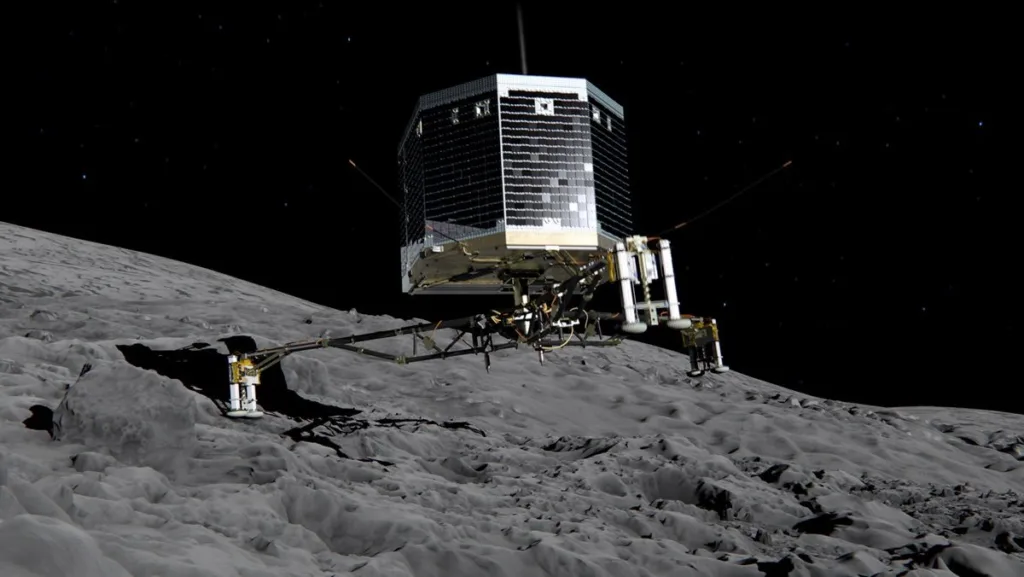
When Philae first touched down on Comet 67P, it didn’t stay put. The European Space Agency had designed harpoons to lock the lander into the comet’s surface, but the harpoons never fired. The result was a dramatic bounce that sent Philae half a mile into space before gravity pulled it back.
The bounce was only the first of three chaotic landings. After drifting for two hours, Philae struck the surface again, this time settling in a dark crevice where sunlight could not reach its solar panels. Because the lander was solar‑powered, it had to face the sun to generate enough power for long‑term operation.
Fortunately, Philae’s batteries supplied power for more than two days, giving its ten instruments a window to conduct science. During that brief window, the lander detected organic molecules that had never before been found on a comet, a milestone in understanding comet composition. Two years after the tumble, the Rosetta orbiter rediscovered Philae lying on its side in a rocky crevice.
The mission’s success—both in rendezvous and in landing—remains a testament to engineering resilience, even when a key component fails.
Our read: Philae’s story reminds us that even when a mission’s primary mechanism fails, the data gathered can still reshape our understanding of the solar system.
The landing shows that persistence and redundancy can turn a near‑miss into a scientific triumph.
The story so far
Earlier coverage connected by shared names and topics. Follow the dates to see how coverage developed; these links do not imply every article describes the same event.
 James Webb Telescope Unveils the Dusty Secret of Interstellar Comet 3I/ATLAS
When the interstellar comet 3I/ATLAS entered our solar system, it brought a puzzle from deep space. Discovered in the summer of 2025,…
Connected by: CometEARLIER COVERAGE- Broadway Meets Apollo in New PBS Space Documentary
We think we know the Apollo story by heart, yet history rarely arrives paired with an orchestra and a cast of Broadway…
Connected by: MissionEARLIER COVERAGE - Hubble’s Star‑Cluster Snapshot Suggests a Captured Ancient Relic
Hubble’s latest image of Messier 30 (M30) shows a glittering sea of stars, some dating back 11.5 to 13.5 billion years—just shy of…
Connected by: BecauseEARLIER COVERAGE - SpaceX Flies Second Mystery Military Mission in Six Days
Two classified military launches in six days reveal a relentless operational pace for SpaceX on the California coast. A Falcon 9 rocket…
Connected by: MissionEARLIER COVERAGE - NOWPhilae’s Bumpy Landing: A Harpoon Failure That Turned a Comet Mission Into a Tale of ResilienceCURRENT UPDATE



Original publication: 13 November 2026 01:49