
Hubble Maps Galactic Core to Prep for Roman Telescope
Densely packed and fiercely bright, the center of our galaxy resists simple study because its stars crowd too close together.
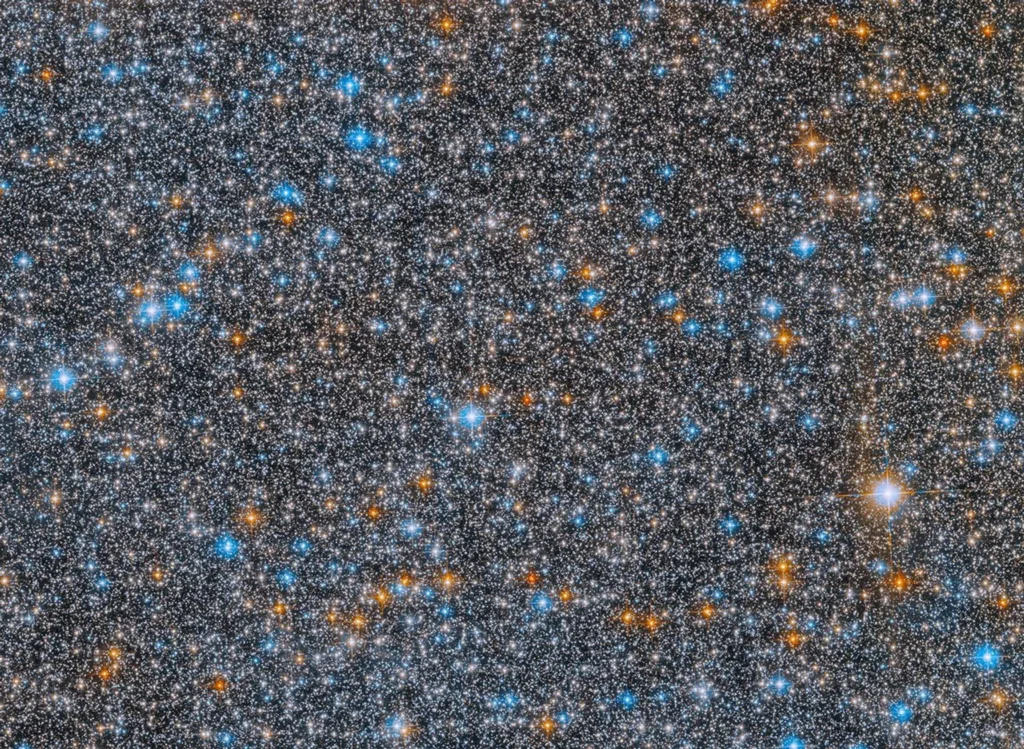
Densely packed and fiercely bright, the center of our galaxy resists simple study because its stars crowd too close together. The Hubble Space Telescope bypasses this jam by using high-resolution optics to separate individual stars in the galactic bulge, a spherical region holding nearly a quarter of the Milky Way's stellar mass.
Hubble targets this crowded zone using wavelengths that overlap with the upcoming Nancy Grace Roman Space Telescope. Roman will collect data primarily in near-infrared and some visible light to search for exoplanets through microlensing events. Microlensing happens when a foreground object magnifies and distorts light from a more distant star along our line of sight.
By capturing baseline data on these stellar fields now, researchers can compare future Roman discoveries against existing Hubble records. Our read suggests this careful cross-calibration will make spotting elusive exoplanets and black holes far more reliable when Roman finally begins its survey work. Watch for how well these overlapping optical baselines hold up once Roman starts recording its first gravitational lensing distortions.
Sources & updates
AI-assisted brief based on the original reporting.
Original report: NASA — Recently Published
Source published: 25 Nov 2026, 20:26
Image credit: NASA — Recently Published
The story so far
Earlier coverage connected by shared names and topics. Follow the dates to see how coverage developed; these links do not imply every article describes the same event.
 Hubble Maps Cosmic Lenses to Prime Roman Telescope for Dark Matter Hunt
Massive foreground galaxies bend and warp background light into striking cosmic mirrors, creating natural magnifying glasses known as gravitational lenses. NASA's Hubble…
Connected by: Nancy Grace Roman SpaceEARLIER COVERAGE- NASA Prepares to Unveil First Images from the Nancy Grace Roman Space Telescope
NASA is getting ready to show the universe through a completely different lens. The agency will stream the very first images from…
Connected by: Nancy Grace Roman SpaceEARLIER COVERAGE - Hubble Captures NGC 4394 to Reveal the Shifting Architecture of Barred Galaxies
Straight streaks of stars cut across the center of galaxy NGC 4394, mirroring a feature astronomers estimate appears in sixty-five percent of…
Connected by: HubbleEARLIER COVERAGE - Hera Arrives at Dimorphos to Inspect Humanity's First Asteroid Crash Site
Humanity's first planetary defense test left a deep scar on a distant space rock, and now a new spacecraft has arrived to…
Connected by: SpaceEARLIER COVERAGE - NOWHubble Maps Galactic Core to Prep for Roman TelescopeCURRENT UPDATE

Original publication: 25 November 2026 20:26