
Namibian salt flats look like an alien planet | Space photo of the day for Oct. 12, 2026
Europe's Copernicus Sentinel-2 mission captured a striking view of Namibia's Etosha Pan from space on April 5, 2026. The image resembles an alien landscape with neon blue pools and bright red surroundings.
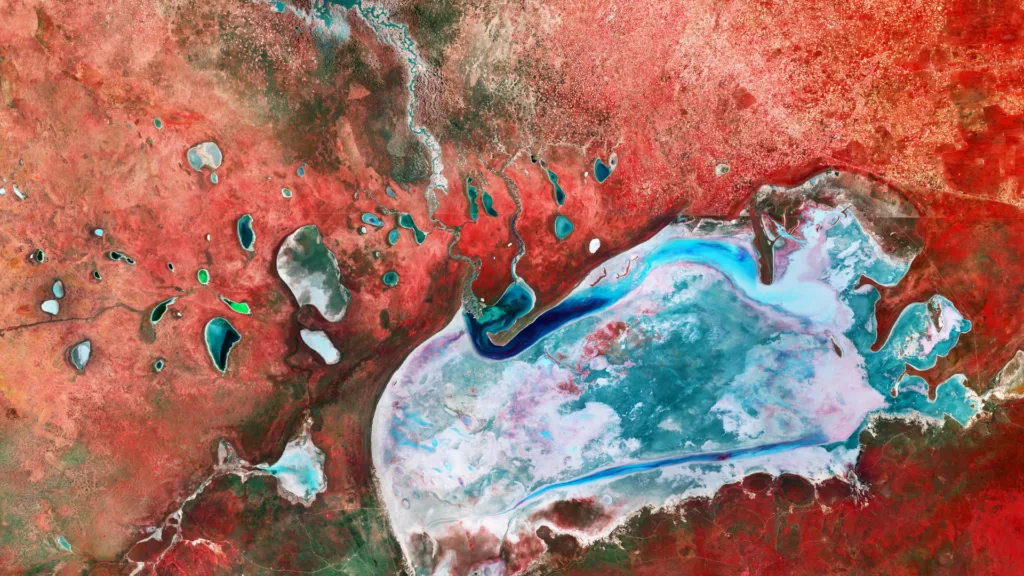
Europe's Copernicus Sentinel-2 mission captured a striking view of Namibia's Etosha Pan from space on April 5, 2026. The image resembles an alien landscape with neon blue pools and bright red surroundings. The Sentinel-2 mission uses two identical satellites equipped with a high-resolution multispectral imager to capture Earth across 13 different spectral bands, or ranges of wavelengths.
While the Etosha Pan actually appears bright white from the ground, researchers used false color to process the satellite data. This technique helps scientists clearly separate different types of topography and vegetation. In the processed image, the surrounding vegetation appears in vibrant red shades. This plant life includes grasslands, savannas, and mopane trees, which serve as essential habitats and shelter for local wildlife like elephants, giraffes, and leopards.
Observing Earth through various spectral bands helps researchers better understand the planet's topography and track how landscapes change over time.
WireUnWired turns the supplied report into a clearer brief, preserves the original publisher and author details, and adds relevant context without hiding where the information came from.
Relevant WireUnWired coverage is connected so one story can lead into the larger technology context.
Original publication: 12 October 2026 19:30
 Space.comSpace and sci-fi themed costumes for adults and children feature popular alien, Star Wars, and Star Trek designs.
 NASA — Recently PublishedNASA Invites Private Industry Proposals to Design and Operate Future Commercial Space Stations
 NASA — Recently PublishedNASA Launches New Metascience Initiative and Doctoral Fellowships to Accelerate Space Innovation