MIT Implant Combines Ultrasound and Drugs to Target Brain Cancer
Surgeons can carve out a visible brain tumor, but microscopic cancer cells almost always remain behind, causing aggressive glioblastoma to return.

Surgeons can carve out a visible brain tumor, but microscopic cancer cells almost always remain behind, causing aggressive glioblastoma to return. Traditional chemotherapy drugs often fail to reach these hidden pockets because the blood-brain barrier blocks them, while passive implants lack active control over timing and distribution. MIT researchers have now built a device designed to bridge that physical gap by combining targeted drug delivery with active sound waves directly inside the brain tissue.
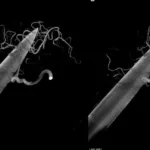
The cardstock-thin implant, named LUCID, pairs a 3D-printed drug-delivery cannula with an array of twenty-four miniature ultrasound transducers. Implanted during surgery, the device relies on a passive osmotic pump and a reservoir to release medications over an extended period. When activated via a wireless Bluetooth controller, the ultrasound transducers generate mechanical oscillations that temporarily increase the permeability of local barriers.
This creates convective flows that push drug molecules to travel significantly further through surrounding tissue than passive diffusion allows. Our read is that combining continuous local infusion with programmable mechanical agitation transforms a blunt pharmacological instrument into a precision tool. Instead of flooding the entire body with toxic chemicals to chase microscopic remnants, doctors could dial in exact dosages to target residual cancer cells directly at the surgical site.
In tests using gel-like tissue models and mice, the research team demonstrated that activating the ultrasound array successfully expanded the reach of delivered molecules.
While the device still faces the long road from animal studies to human clinical trials, the team envisions broader applications beyond the brain.
The physical architecture could eventually adapt to deliver immunotherapies, gene therapies, or treatments across other soft tissue organs.
For now, the primary challenge remains translating these controlled dispersion gains into prolonged survival for patients facing one of medicine's most stubborn diagnoses.
The story so far
Earlier coverage connected by shared names and topics. Follow the dates to see how coverage developed; these links do not imply every article describes the same event.
 Monash University Study Shows Psilocybin Organizes Brain Activity Into Distinct Pathways Across Different Environmental Contexts
A recent study published in Nature reveals that while the brain appears chaotic under the influence of psilocybin, a hidden order emerges…
Connected by: BrainEARLIER COVERAGE- Rivian buys world model startup to accelerate self-driving ambitions
Electric vehicle maker Rivian has acquired Third Dimension, a United Kingdom startup that uses artificial intelligence to convert images and video into…
Connected by: TraditionalEARLIER COVERAGE - NOWMIT Implant Combines Ultrasound and Drugs to Target Brain CancerCURRENT UPDATE

Original publication: 26 October 2026 20:30