Turning Off the Lighthouse Reveals a Hidden Giant
Sometimes seeing more in astronomy requires turning off the light, or at least pretending to.
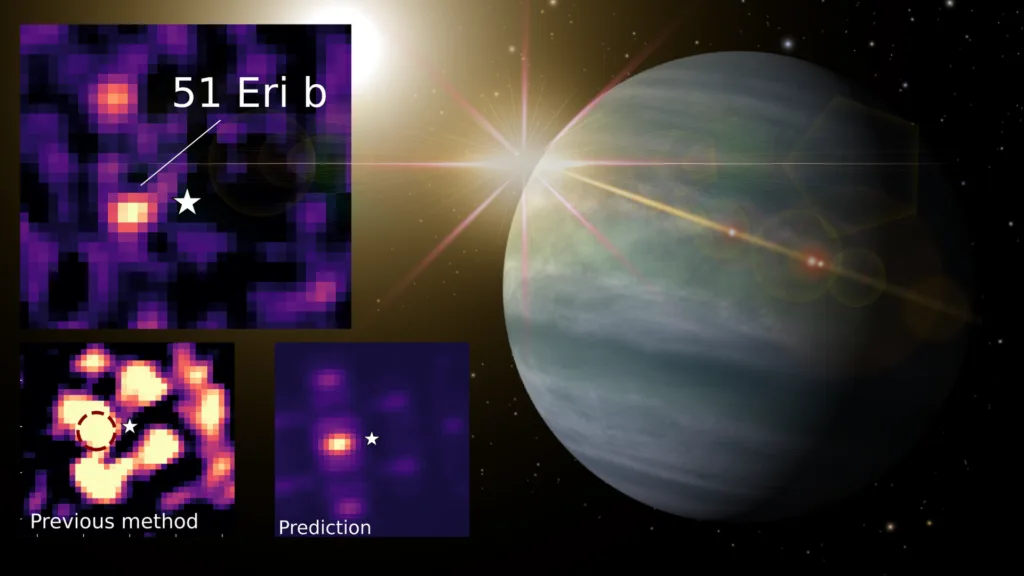
Sometimes seeing more in astronomy requires turning off the light, or at least pretending to. When the James Webb Space Telescope first stared at the star system ninety-seven light-years away, an eleven-Jupiter-mass gas giant named 51 Eridani b was completely missing from the data. The oversight was not a failure of the powerful observatory.
Even with hardware coronagraphs blocking direct glare, host stars shine up to one hundred thousand times brighter than their orbiting planets, making a distant world look like a firefly hovering beside a lighthouse. Standard processing tries to subtract this glare using reference images of other stars, but tiny mechanical vibrations from telescope cryocoolers shift the mirrors just enough to scatter light and hide the targets.
To solve this, researchers at Northwestern University built a virtual replica that simulates how light travels through the telescope's physical mirrors and detectors. This digital twin fine-tunes itself against millions of tiny optical imperfections until it matches real observatory behavior, creating a precise model of the unwanted glare.
When the team applied this virtual subtraction to archival observations taken two years ago, the missing gas giant finally emerged from the data.
Our read is that this shifts the bottleneck of modern space astronomy from hardware collection to algorithmic rescue, proving that major discoveries are waiting inside data we have already gathered.
The new technique, called Physics-based Learning for Imaging Planets, outperformed traditional image-processing methods up to fifteen times across multiple test systems.
That success suggests astronomers can recover a massive backlog of science left sitting on lab tables.
Team leader Rodrigo Ferrer-Chavez notes that our inability to spot Earth-like worlds so far reflects our tools rather than reality.
As researchers adapt this software approach for future projects like NASA's proposed Habitable Worlds Observatory, sharpening our digital lenses may finally answer whether our solar system is an anomaly or the cosmic norm.
The story so far
Earlier coverage connected by shared names and topics. Follow the dates to see how coverage developed; these links do not imply every article describes the same event.
 A Retired Telescope Catches the Universe in Its Aluminum Eye
A massive aluminum dish once tuned to the hidden whispers of the cosmos now does something far simpler, catching the stars in…
Connected by: TelescopeEARLIER COVERAGE- Hubble and Webb Capture the Ghostly Cat's Head Nebula in New Halloween Views
A glowing red eye peers out from a massive cloud of cosmic dust, looking right at home in a witch's cauldron. Released…
Connected by: James Webb Space TelescopeEARLIER COVERAGE - James Webb Telescope Unveils the Dusty Secret of Interstellar Comet 3I/ATLAS
When the interstellar comet 3I/ATLAS entered our solar system, it brought a puzzle from deep space. Discovered in the summer of 2025,…
Connected by: James Webb Space TelescopeEARLIER COVERAGE - New Software Tames Starlight Blur to Bring Hidden Exoplanets Into View
Starlight is blindingly bright, drowning out the faint glimmer of orbiting worlds that astronomers desperately want to see. Even when telescopes use…
Connected by: TelescopeEARLIER COVERAGE - NOWTurning Off the Lighthouse Reveals a Hidden GiantCURRENT UPDATE



Original publication: 6 November 2026 22:30