
⚡ WireUnwired Research • Key Insights
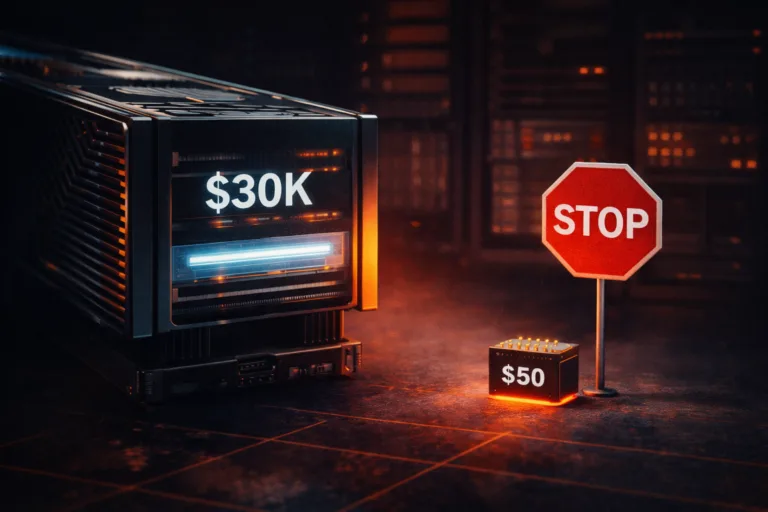
- The Shift: For 20 years, chips were built on organic plastic (ABF). By 2026, Intel and Samsung will shift to Glass Core Substrates.
- The Driver: AI chips have become too hot and massive. Plastic warps under the heat, snapping the delicate connections. Glass stays flat.
- The Roadmap: High-end AI servers get it first (2026). Your laptop gets it later (2028+).
The Invisible Skeleton of AI
We talk a lot about the “Brain” of the chip (the 2nm transistors). But we rarely talk about the “Skeleton” (the substrate).
For 20 years, every high-performance chip—from your Intel Core i9 to the NVIDIA H100—has been built on a foundation of organic plastic (known as ABF).
It is cheap. It is reliable. And as of 2026, it is officially broken.
The new generation of AI chips has become so massive and hot that plastic can no longer hold them. The industry is making its most dangerous pivot in decades: We are switching the skeleton to Glass.
Problem 1: The “Wobbly Canvas” (Warpage)
Why ditch plastic? Because of Warpage.
Imagine trying to paint a microscopic masterpiece (lithography) on a canvas that keeps bending and warping in the heat. That is what happens to plastic substrates when you attach a massive GPU to them.
- The Heat: AI chips get incredibly hot. Plastic expands.
- The Warp: When plastic expands, it bends. The tiny copper wires disconnect. The chip dies.
%%{init: {'theme': 'dark', 'themeVariables': { 'primaryColor': '#222', 'edgeLabelBackground':'#111', 'tertiaryColor': '#222'}}}%%
graph TD
    subgraph PLASTIC [Old Way: Plastic Substrate]
        A[High AI Heat 100°C+] -->|Melts Plastic| B(Expands Rapidly)
        B --> C{Result: Warpage}
        C -->|Wires Snap| D[CHIP FAILURE]
    end

    subgraph GLASS [New Way: Glass Core]
        X[High AI Heat 100°C+] -->|Glass Resists| Y(Zero Expansion)
        Y --> Z{Result: Flatness}
        Z -->|Wires Safe| W[CHIP STABLE]
    end

    style D fill:#770000,stroke:#ff0000,stroke-width:2px,color:#fff
    style W fill:#005500,stroke:#00ff00,stroke-width:2px,color:#fff
    style A fill:#222,stroke:#fff,color:#fff
    style B fill:#222,stroke:#fff,color:#fff
    style C fill:#222,stroke:#fff,color:#fff
    style X fill:#222,stroke:#fff,color:#fff
    style Y fill:#222,stroke:#fff,color:#fff
    style Z fill:#222,stroke:#fff,color:#fff
[Deep Dive: The Math of Stiffness]
The resistance to bending (warpage) is determined by a material’s Young’s Modulus (\(E\)).
- Organic Plastic (\(E_{organic}\)): \(\approx 25 \text{ GPa}\) (Floppy)
- Glass (\(E_{glass}\)): \(\approx 75 \text{ GPa}\) (Stiff)
The Warpage Equation:
The amount a material warps (\(w\)) under thermal stress is inversely proportional to its stiffness:
$$w \propto \frac{\alpha \cdot \Delta T}{E}$$
Because Glass has a much higher \(E\) (stiffness) and a lower \(\alpha\) (expansion) that matches Silicon, the warpage (\(w\)) drops to near zero.
Problem 2: The “Swiss Cheese” Limit (Density)
But stiffness is only half the story. The real reason AI needs glass is Bandwidth.
To move data between memory and the GPU, we have to drill vertical holes through the substrate. These are called Vias.
Plastic is soft. If you drill holes too close together (closer than 325 microns), the material crumbles. It’s a physical limit.
Glass is different.
Using lasers (LIDE – Laser Induced Deep Etching), engineers can drill incredibly clean, microscopic holes called Through-Glass Vias (TGVs). They can be spaced just 30-50 microns apart.
The Result?
You can pack 10x more wires into the same space. Plastic is a 4-lane highway. Glass is a 40-lane superhighway.
Discover more from WireUnwired Research
Subscribe to get the latest posts sent to your email.