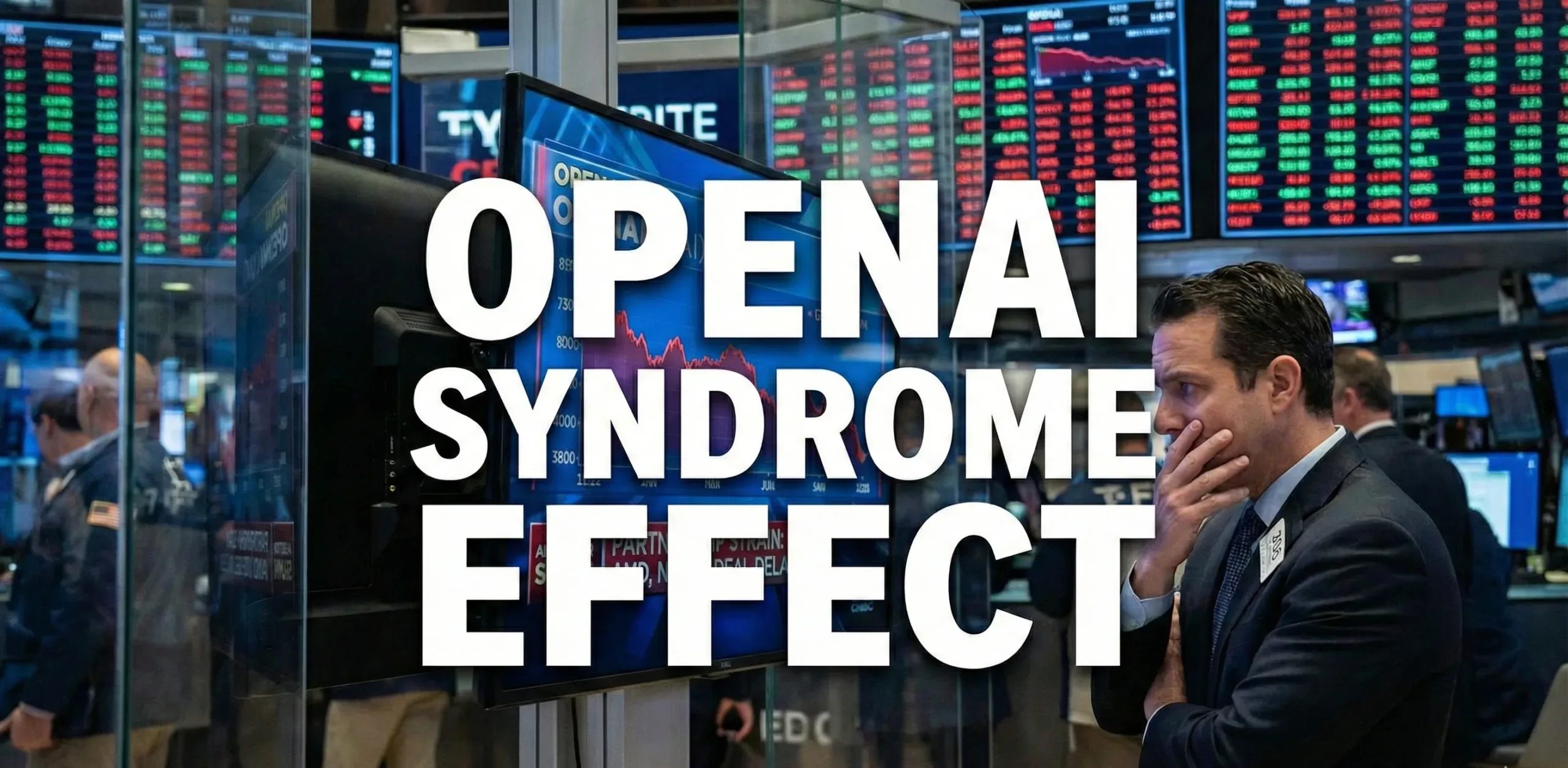

Something strange is happening to companies that partner with OpenAI. Microsoft reports strong earnings and rising AI revenue—stock drops. AMD posts solid results with optimistic guidance—shares fall in after-hours trading. Oracle commits billions to OpenAI data centers—lenders start pulling back over default concerns. The pattern is consistent enough that it now has a name: “OpenAI syndrome.”
The term comes from DIGITIMES analyst Luke Lin, but the phenomenon he’s describing has been visible for months. Tech companies announce partnerships with OpenAI, generate headlines, watch their stocks pop briefly—then face sharp selloffs when those partnerships don’t convert into binding contracts or measurable revenue. Markets are losing patience with memorandums of understanding that never become purchase orders.
What’s driving this? Lin points to a fundamental commercial discipline problem. OpenAI announces cooperation agreements with multiple firms simultaneously—AMD, Broadcom, Nvidia, Microsoft, Oracle, various startups—but these agreements remain perpetually in “discussion” phase without converting to executed contracts. For companies that invest billions building infrastructure based on projected OpenAI demand, this creates serious financial exposure.
⚡
WireUnwired • Fast Take
- “OpenAI syndrome”—tech partners see stock drops despite strong earnings
- Microsoft, AMD, Oracle all hit: partnership announcements don’t convert to firm contracts
- Root cause: Sam Altman announces multiple partnerships without commercial follow-through
- Risk: AI infrastructure overcapacity if OpenAI demand projections don’t materialize

The most visible example: Nvidia and OpenAI announced a cooperation plan covering investment and compute resources worth up to $100 billion. Months later, it remains an MOU without a formal contract. For Nvidia, this isn’t necessarily problematic—they sell chips to everyone and don’t depend on OpenAI alone. For companies like Oracle that have borrowed heavily to build OpenAI-specific infrastructure, or Microsoft that has committed tens of billions in compute subsidies, the lack of binding agreements creates real financial exposure.
Lin’s framing—comparing Altman to a “serially unfaithful partner”—captures market frustration. OpenAI engages with multiple technology providers simultaneously, generating headlines and partnership announcements that boost visibility and negotiating leverage. But when those partnerships don’t convert to purchase orders, the companies that invested based on projected demand face capacity they can’t fill and debt they struggle to service.
This creates a structural problem for AI infrastructure investment. The current buildout surge—memory shortages, glass substrate constraints, fab capacity expansion—is driven largely by forward projections of compute demand. Companies like Samsung, SK Hynix, and TSMC are scaling production based on what OpenAI and similar AI labs say they’ll need in 2026, 2027, 2028. If those projections prove inflated or if partnerships fail to materialize into binding purchase commitments, the entire supply chain faces overcapacity and sharp pricing corrections.
The warning signs are already visible. Oracle’s debt load for OpenAI data centers has spooked lenders enough that some US banking syndicates are pulling back, questioning whether Oracle can service those obligations if OpenAI’s actual compute consumption doesn’t match projections. Microsoft’s stock reaction suggests investors are applying similar skepticism to its OpenAI subsidies—strong earnings today don’t guarantee those AI infrastructure investments will generate proportional returns tomorrow.
AMD’s situation illustrates the contagion risk. The company isn’t as deeply tied to OpenAI as Microsoft or Oracle, but market perception groups it with “OpenAI partners” because of announced AI chip collaborations.
Even solid operational performance can’t overcome investor concern that announced partnerships won’t convert to revenue if the broader OpenAI ecosystem underperforms expectations.
This dynamic puts enormous pressure on OpenAI to demonstrate commercial discipline. The company has raised unprecedented capital—over $10 billion in recent funding rounds—but converting that into sustained revenue requires actually executing on partnership agreements rather than just announcing them. Every quarter that major partnerships remain at the MOU stage rather than converting to binding contracts reinforces market skepticism about whether projected AI demand will materialize.
The implications extend beyond individual companies to the entire AI infrastructure investment cycle. If the market concludes that OpenAI’s partnership announcements are more vapor than substance, capital allocation shifts dramatically. Companies stop building speculative capacity for projected AI demand. Supply chains contract rather than expand. Pricing for components like HBM memory and advanced packaging corrects downward as overcapacity becomes apparent.
Lin identifies late 2027 as the critical inflection point. By then, current partnership MOUs should have converted to executed projects with measurable revenue impact, or the market will conclude they won’t materialize. Post-2027 demand projections—currently driving billions in infrastructure investment—face sharp downward revision if cooperation agreements remain unexecuted.
For investors, OpenAI syndrome creates a paradox. Companies reporting strong AI-related earnings face stock pressure because markets don’t trust that current success will continue if OpenAI partnerships don’t convert. Companies announcing new OpenAI partnerships see initial pops followed by skepticism-driven selloffs when contracts don’t materialize. The syndrome persists until either OpenAI demonstrates commercial execution discipline or the market stops pricing in partnership announcements as material events.
Whether OpenAI syndrome proves temporary or marks the beginning of a broader AI investment correction depends entirely on execution. If OpenAI and its partners convert MOUs to contracts and projected demand to actual purchases, the syndrome fades and infrastructure investment continues. If partnerships remain vaporware and demand projections prove inflated, the correction could be severe—affecting not just individual companies but the entire AI supply chain that scaled capacity based on those projections.
For now, markets are applying increasing skepticism to any company whose growth story depends heavily on OpenAI partnerships. Strong earnings aren’t enough. Investors want binding contracts, measurable revenue, and proof that announced cooperations will actually execute. Until that proof arrives, OpenAI syndrome continues spreading through every sector of the AI infrastructure ecosystem.
For discussions on AI infrastructure investment, semiconductor markets, and tech partnerships, join our WhatsApp community where investors and analysts discuss market developments.
Discover more from WireUnwired Research
Subscribe to get the latest posts sent to your email.