
Scientists solve 1840s space weather mystery
Researchers publishing in the journal Space Weather have resolved a mystery regarding an 1841 report of a magnetic disturbance disrupting rail travel in Exeter, England.
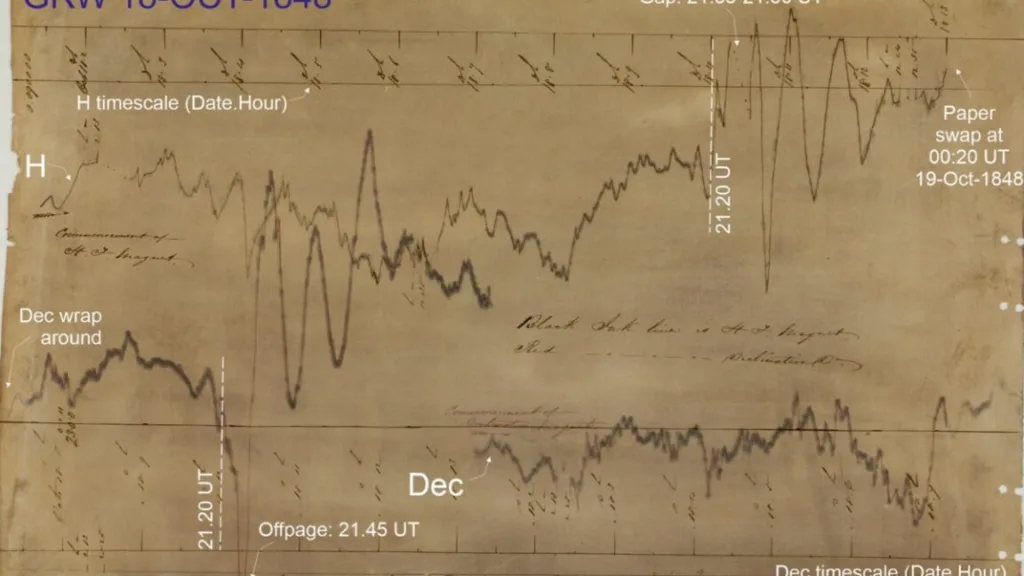
Researchers publishing in the journal Space Weather have resolved a mystery regarding an 1841 report of a magnetic disturbance disrupting rail travel in Exeter, England. Scholars initially found the anonymous 1871 Nature account in 2013, which described the October 1841 Exeter incident as potentially the earliest account of space weather impacting technology.
However, the new study indicates the 1841 date is likely a typo, with the railway disruption actually happening years later. Co-author Jim Wild of Lancaster University noted that society has felt space weather effects on technology nearly as long as electrical technologies have existed, highlighting the Exeter train delay as an event where emerging technology first met the space environment.
While minor telegraph disturbances date back to the late 1840s, the 1859 Carrington Event remains the scientific record's most powerful geomagnetic storm. Triggered by a likely coronal mass ejection, the Carrington Event caused global auroras, sparked telegraph fires, and disabled systems, though some operators could still transmit messages by disconnecting power and using the auroral current alone.
WireUnWired turns the supplied report into a clearer brief, preserves the original publisher and author details, and adds relevant context without hiding where the information came from.
Relevant WireUnWired coverage is connected so one story can lead into the larger technology context.
 Ars TechnicaNASA issues long-awaited call to industry for private space stations
 Ars TechnicaAmazon builds its 1,000th low-Earth orbit satellite and prepares to launch commercial space internet service.
 Ars TechnicaMassachusetts court filings reveal ExxonMobil scientists internally doubted climate solutions the company promoted publicly.