
On this day in space! Oct. 13, 1773: Astronomer Charles Messier discovers the Whirlpool Galaxy before we ever knew it was a galaxy
On October 13, 1773, French astronomer Charles Messier discovered the Whirlpool Galaxy, cataloging it as M51. Messier worked as the chief astronomer of the Marine Observatory in Paris.
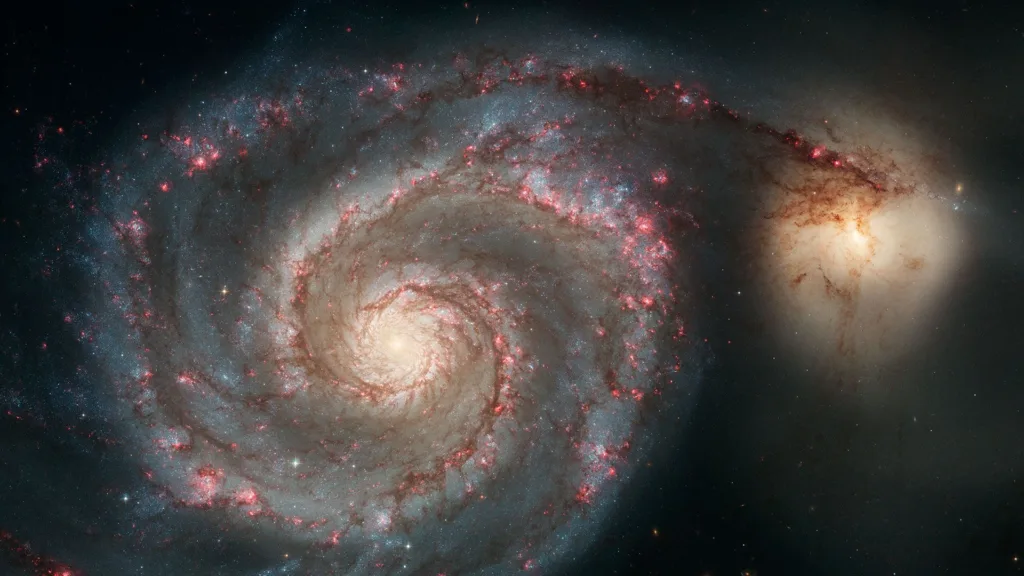
On October 13, 1773, French astronomer Charles Messier discovered the Whirlpool Galaxy, cataloging it as M51. Messier worked as the chief astronomer of the Marine Observatory in Paris. He was scanning the sky for fuzzy objects that could confuse comet hunters. At the time of its discovery, Messier could not see the spiral structure of M51 and failed to identify it as a galaxy.
Seventy-two years later, astronomer William Parsons observed the whirlpool shape and mistook it for a spiral nebula. Edwin Hubble later proved that M51 and similar features are galaxies. Located about 31 million light-years from Earth in the constellation Venatici, M51 is considered a textbook spiral galaxy. It has a magnitude of 8.4 on the astronomical brightness scale, allowing observers to view it through a small telescope.
Scientists using NASA's Spitzer Space Telescope suspect that a close gravitational interaction with a neighboring galaxy, NGC 5195, caused M51's striking spiral shape. Researchers state that this neighbor may have passed through the main disk of M51 about 500 million years ago, compressing gas and triggering increased star formation.
WireUnWired turns the supplied report into a clearer brief, preserves the original publisher and author details, and adds relevant context without hiding where the information came from.
Relevant WireUnWired coverage is connected so one story can lead into the larger technology context.
Original publication: 14 October 2026 02:30
 NASA — Recently PublishedSpaceX Falcon 9 Launches NASA CRS-35 Cargo Mission to the International Space Station on October 13NASA — Recently PublishedNASA Prepares SpaceX CRS-35 Mission to Launch Human Health and Plant Experiments to Space Station
 NASA — Recently PublishedNASA Invites Private Industry Proposals to Design and Operate Future Commercial Space Stations