

⚡ WireUnwired Research • Deep Dive
- The News: TSMC’s upcoming 2nm (N2) wafers are projected to cost nearly $30,000 each.
- The Context: As we reported previously, Apple has secured 100% of TSMC’s initial 2nm capacity.
- The Math: We used the WireUnwired Silicon Calculator to prove why Apple can survive this cost structure while competitors cannot.
The Price of Physics
Moore’s Law used to be free. You shrunk the transistor, and the chip got cheaper. That era is dead.
As we move to the 2nm Node (N2) in 2026, the economics of manufacturing are inverting. Reports indicate that TSMC’s N2 wafers will cost roughly $30,000. For comparison, a standard 5nm wafer was only ~$17,000.
Why the jump? It’s the move to GAA (Gate-All-Around) transistors. Building these microscopic “Nano-Sheets” requires more EUV layers and vastly more expensive tools.
Case Study 1: The “Yield Trap” (NVIDIA B200)
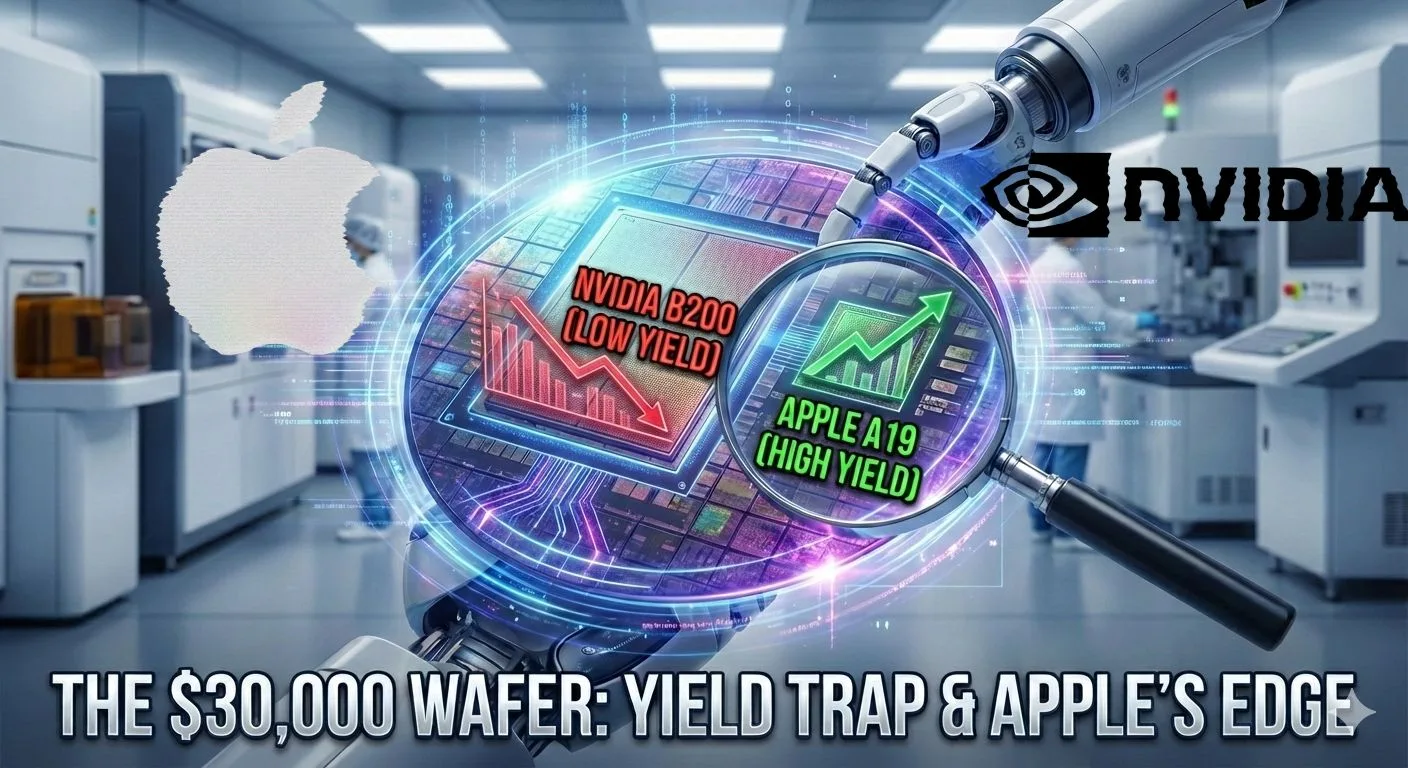
A $30,000 wafer is terrifying for massive AI chips. To see why, we used our calculator to simulate an NVIDIA B200 (approx. 800mm²) with early-stage defects (0.5 defects/cm²).
The Result: The “Large Die Penalty” crushed the yield to just 5.9%. The manufacturing cost per chip exploded from a manageable $933 to a staggering $10,000.
%%{init: {
  'theme': 'base',
  'themeVariables': {
    'fontFamily': 'inherit',
    'primaryColor': '#1a1a1a',
    'mainBkg': '#0d0d0d',
    'nodeBorder': '#00ffff',
    'clusterBkg': '#111',
    'clusterBorder': '#444',
    'lineColor': '#00ffff',
    'textColor': '#fff',
    'fontSize': '16px',
    'xyChart': {
        'backgroundColor': '#0d0d0d',
        'titleColor': '#fff',
        'xAxisLabelColor': '#fff',
        'xAxisTitleColor': '#fff',
        'yAxisLabelColor': '#fff',
        'yAxisTitleColor': '#fff',
        'plotColorPalette': '#00ffff, #ff0055'
    }
  }
}}%%
xychart-beta
    title "NVIDIA B200 Mfg Cost: Mature vs Early Yield"
    x-axis ["Mature (D0=0.09)", "Early Risk (D0=0.5)"]
    y-axis "Cost Per Chip ($)" 0 --> 11000
    bar [933, 10000]
This explains why NVIDIA is waiting. At these yields, a single wafer creates mostly trash, burning huge amounts of capital.
Case Study 2: The “Apple Immunity” (Why They Bought It All)
Do you remember our recent article? We broke the news that Apple has secured 100% of TSMC’s 2nm capacity for the upcoming A19 chip.
At the time, it seemed like a standard “luxury flex”—Apple just throwing cash around to be first. But running the numbers on our Silicon Economics Calculator reveals the mathematical truth. Apple didn’t just buy the capacity because they have the money. They bought it because they are the only ones who can survive the physics.
We ran a second simulation for the upcoming Apple A19 Pro (105mm²) using the exact same “Disaster” settings (0.5 defects, $30k wafer).
%%{init: {
  'theme': 'base',
  'themeVariables': {
    'fontFamily': 'inherit',
    'primaryColor': '#1a1a1a',
    'mainBkg': '#0d0d0d',
    'nodeBorder': '#00ffff',
    'clusterBkg': '#111',
    'clusterBorder': '#444',
    'lineColor': '#00ffff',
    'textColor': '#fff',
    'fontSize': '16px',
    'xyChart': {
        'backgroundColor': '#0d0d0d',
        'titleColor': '#fff',
        'xAxisLabelColor': '#fff',
        'xAxisTitleColor': '#fff',
        'yAxisLabelColor': '#fff',
        'yAxisTitleColor': '#fff',
        'plotColorPalette': '#00ffff, #ff0055'
    }
  }
}}%%
xychart-beta
    title "Yield Survival: Small Die (Apple) vs Large Die (NVIDIA)"
    x-axis ["Apple A19 (Small Die)", "NVIDIA B200 (Large Die)"]
    y-axis "Yield (%)" 0 --> 100
    bar [60.1, 5.9]
The “Apple Tax” is Coming
Because the iPhone chip is physically small, it can dodge the defects. While NVIDIA loses 94% of its silicon, Apple keeps 60% of it. This results in a manufacturing cost of roughly $87.21 per chip.
However, this is still expensive. A standard 3nm chip costs closer to $50. Apple has two choices: eat the margin or pass it on. Given the $30,000 wafer price, we expect the iPhone 18 Pro to carry a premium.
The WireUnwired Takeaway
In the 2nm era, wafer price is vanity; yield is sanity.
If you want to understand why your next phone will cost more, look at the wafer cost. Apple is paying a premium to be first, but the laws of silicon economics dictate that we will ultimately foot the bill.
🧮 Prove the Math Yourself
We used the NVIDIA B200 and Apple A19 for this example. Want to see what happens if the wafer price drops to $25,000?
➜ Launch Silicon Economics CalculatorDiscover more from WireUnwired Research
Subscribe to get the latest posts sent to your email.