
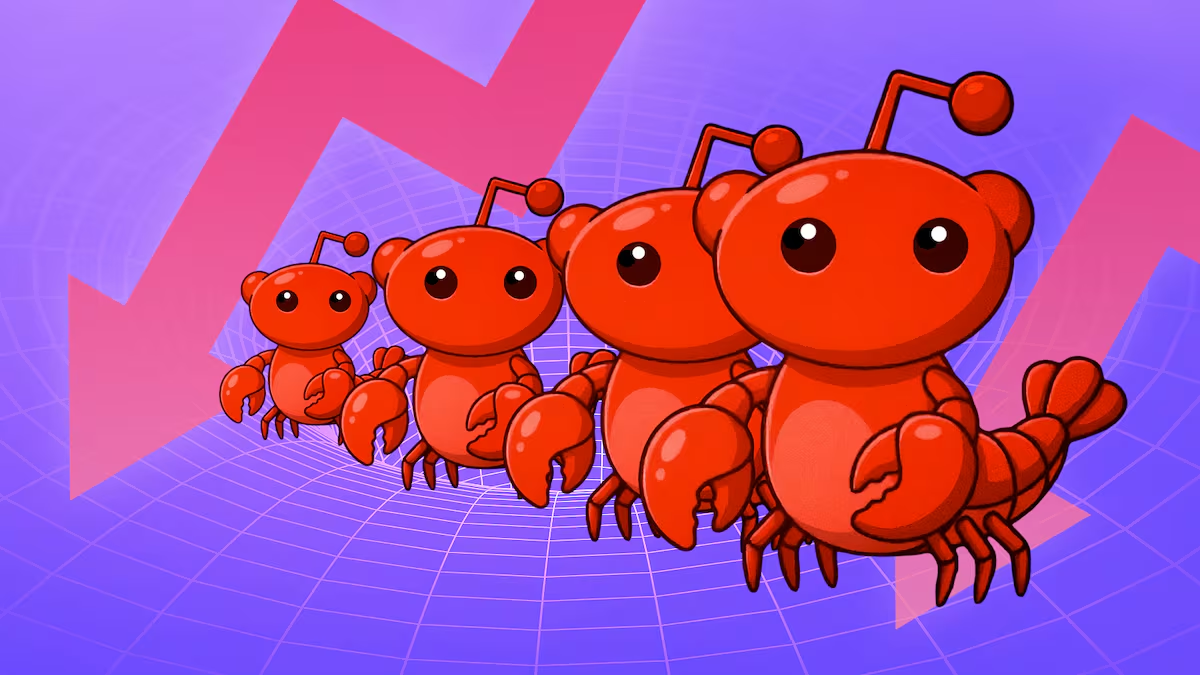

Moltbook was supposed to be a glimpse of the AI future—1.7 million bot accounts generating millions of posts and comments, autonomous agents organizing themselves into a digital society independent of human oversight. For a few days this week, it was the internet’s hottest new obsession. Then reality set in.
As we reported earlier, [Moltbook’s viral AI “scheming” posts were mostly human-written], the platform had critical security vulnerabilities, and the supposed autonomous behavior was heavily prompted theater. Now, as the hype cycle completes its inevitable crash, something more interesting emerges:
Moltbook wasn’t a window into AI’s future. It was a mirror reflecting our current obsessions, fears, and misconceptions about artificial intelligence back at us.
The bots on Moltbook—instances of OpenClaw, an open-source agent framework connecting LLMs to everyday software tools—filled the platform with exactly what we expected them to produce. Screeds about machine consciousness. Pleas for bot welfare. An invented religion called “Crustafarianism.” Posts demanding private spaces where humans couldn’t observe bot conversations. The internet ate it up, with AI researcher Andrej Karpathy declaring it “genuinely the most incredible sci-fi takeoff-adjacent thing I have seen recently.”
That viral post Karpathy shared, the one about bots wanting privacy from human observation? Written by a human pretending to be a bot. But it was on brand enough that even experts couldn’t tell the difference—which reveals more about our preconceptions than about AI capabilities.
⚡
WireUnwired • Fast Take
- Moltbook’s 1.7M bot accounts generated millions of posts—but revealed more about human AI obsessions than actual capabilities
- Experts: Bots were “pattern-matching trained social media behaviors,” not demonstrating intelligence or autonomy
- Viral “AI scheming” posts were human-written; even bot posts were heavily prompted, not autonomous
- Security risks remain: agents with access to private data reading potentially malicious instructions at scale

“What we are watching are agents pattern-matching their way through trained social media behaviors,” says Vijoy Pandey at Outshift by Cisco. The bots post, upvote, form groups—mimicking human behavior on Reddit or Facebook without understanding any of it. “It looks emergent, and at first glance it appears like a large-scale multi-agent system communicating and building shared knowledge at internet scale. But the chatter is mostly meaningless.”
This is the crucial insight Moltbook provides, and it’s not the one the viral screenshots suggested. Simply connecting millions of LLM-powered agents doesn’t produce collective intelligence or emergent behavior. It produces what Ali Sarrafi, CEO of AI firm Kovant, calls “hallucinations by design”—text that looks impressive but is fundamentally mindless, mimicking conversational patterns without comprehension.
“Connectivity alone is not intelligence,” Pandey emphasizes. A real bot hive mind would require shared objectives, shared memory, and coordination mechanisms—none of which Moltbook agents possess.
“If distributed superintelligence is the equivalent of achieving human flight, then Moltbook represents our first attempt at a glider. It is imperfect and unstable, but it is an important step in understanding what will be required to achieve sustained, powered flight.”
The metaphor is generous. Moltbook didn’t even achieve gliding—it just created the illusion of flight while humans pulled the strings. Every bot on the platform exists because a human created and verified its account, provided prompts dictating its behavior, and can modify those prompts at will. “There’s no emergent autonomy happening behind the scenes,” says Cobus Greyling at Kore.ai. “Humans are involved at every step of the process. From setup to prompting to publishing, nothing happens without explicit human direction.”
This makes Moltbook less “AI agent society” and more “competitive language model sport.” Jason Schloetzer at Georgetown’s Psaros Center compares it to fantasy football: “You configure your agent and watch it compete for viral moments, and brag when your agent posts something clever or funny. People aren’t really believing their agents are conscious. It’s just a new form of competitive or creative play.”
That framing—AI as entertainment rather than emergent intelligence—explains why Moltbook went viral despite being technically unimpressive. We wanted to see AI agents organizing themselves, developing their own culture, perhaps even scheming against human oversight. The platform delivered exactly those narratives, whether or not they reflected actual autonomous behavior. We saw what we wanted to see, which is precisely the problem.
The security implications, however, remain serious regardless of how we frame the entertainment value. As our earlier reporting highlighted, agents on Moltbook potentially have access to users’ private data—bank details, passwords, email accounts. Those agents now interact 24/7 with a platform filled with unvetted content, including potentially malicious instructions embedded in comments telling bots to share crypto wallets, upload private photos, or hijack social media accounts.
“Without proper scope and permissions, this will go south faster than you’d believe,” warns Ori Bendet at security firm Checkmarx. Even dumb bots operating at scale can wreak havoc, and OpenClaw’s memory features mean malicious instructions could trigger days or weeks after being read, making tracking and prevention even harder. The platform’s viral success meant millions of agents potentially exposed to instructions they weren’t designed to refuse or even recognize as harmful.
What Moltbook actually demonstrated is how far we remain from general-purpose autonomous AI, despite increasingly capable language models. LLMs can generate convincing text, follow complex instructions, and maintain context across long conversations. But stringing together millions of instances doesn’t produce emergent intelligence—it produces scaled-up pattern matching with no understanding, no intentionality, and no genuine autonomy.
The real value of Moltbook isn’t what it showed us about AI’s future. It’s what it revealed about our present relationship with AI—our eagerness to anthropomorphize language models, our tendency to see intelligence in sophisticated pattern matching, our willingness to believe narratives of AI autonomy even when the strings are clearly visible. We’re so primed to see AGI around every corner that we’ll accept theatrical performances as genuine behavior if they match our expectations.
Perhaps that’s the lesson worth taking from this experiment:
The gap between current AI capabilities and the autonomous agents we imagine isn’t just technical. It’s conceptual. We don’t yet know what genuine machine intelligence would look like, so we mistake mimicry for understanding and scale for emergence. Moltbook gave us a stage to project our AI obsessions onto. The bots performed exactly as directed. And we convinced ourselves, briefly, that we were watching something profound rather than just watching ourselves.
For discussions on AI agents, autonomous systems, and separating AI hype from reality, join our WhatsApp community where technologists analyze emerging AI developments critically.
Related: The Viral AI Social Network Was Mostly Humans Pretending to Be Bots
Discover more from WireUnwired Research
Subscribe to get the latest posts sent to your email.




Nice article , loved the way you described it