
For years, Meta was the good guy of the AI race. While OpenAI and Google locked their models behind paywalls, Meta was handing out Llama like candy — free to download, free to build on, free to run on your own machine. Developers loved them for it. By early 2026, the Llama ecosystem had crossed 1.2 billion downloads, a million new ones every single day.
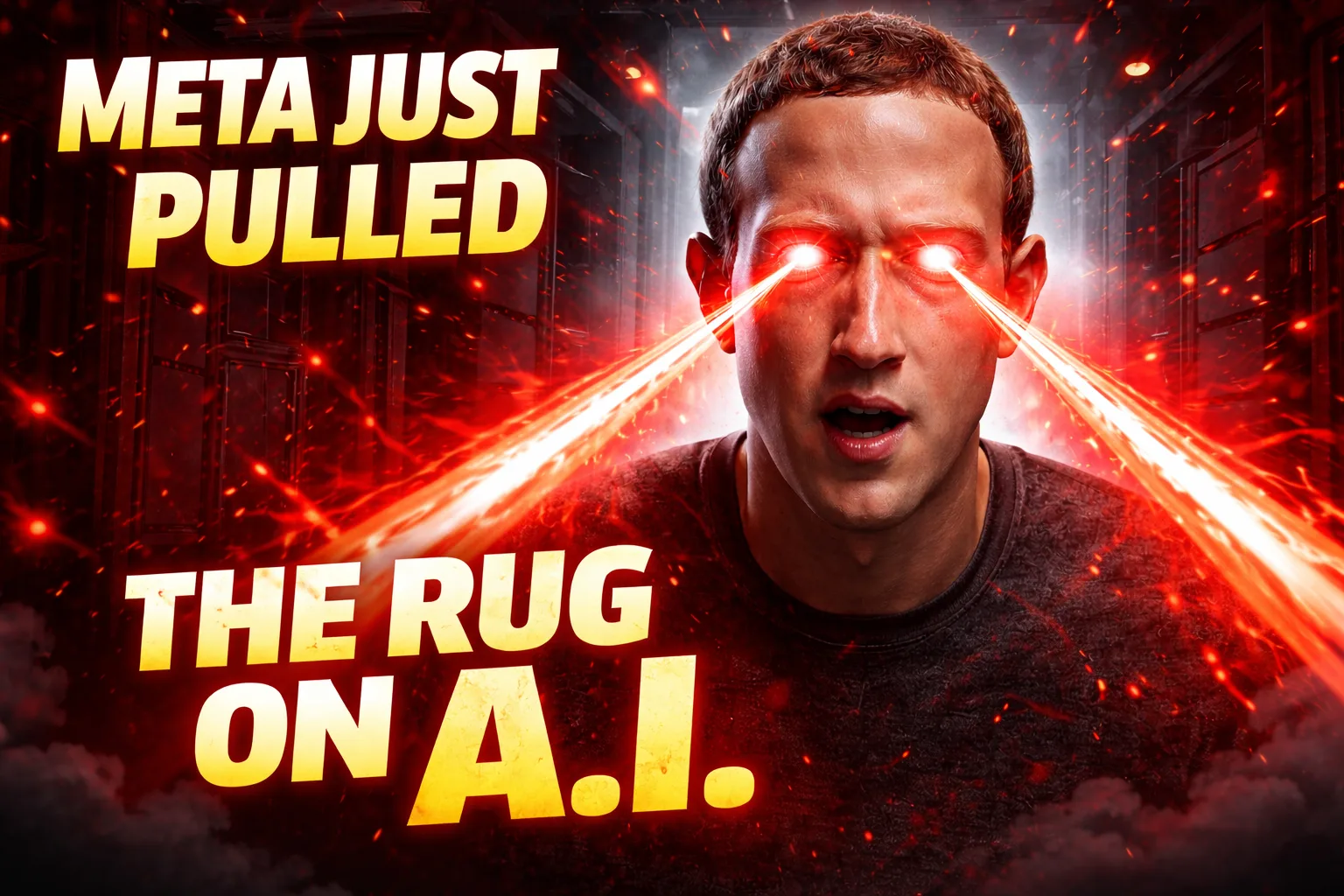
Then came April 8, 2026. And just like that, everything flipped.
Meet Muse Spark — Meta’s first fully proprietary model. No open weights, no free download, invite-only API. It’s the debut product of their newly formed Meta Superintelligence Labs, and the result of a nine-month, $14.3 billion ground-up rebuild of their entire AI stack. New infrastructure, new architecture, all of it from scratch. This is what came out the other side.
“Spending $14.3 billion to rebuild your entire AI stack is not a product decision. It’s a statement of intent — and Muse Spark is Meta telling the industry it’s done playing catch-up.” — WireUnwired
And honestly? The engineering is impressive. Muse Spark is multimodal, reasons visually, uses tools natively, and can orchestrate multiple AI agents simultaneously. It now powers Meta AI across Facebook, Instagram, WhatsApp, Messenger, and the Ray-Ban smart glasses. Oh, and it matches older Llama 4 performance at a fraction of the compute cost — which at Meta’s scale translates to hundreds of millions in savings.
On the global leaderboard it sits fourth, scoring 52 on the AI Index v4.0, behind Gemini 3.1 Pro, GPT-5.4, and Claude Opus 4.6. Notably, Meta isn’t pretending otherwise. After Llama 4’s credibility took a beating from overpromising, they clearly decided honesty was the better move this time.
Where Muse Spark genuinely pulls ahead is health. It scores 42.8 on HealthBench Hard — nearly double Gemini 3.1 Pro’s 20.6. Over 1,000 physicians helped build its training data, and you can feel the difference. It also ships in three modes: Instant for quick answers, Thinking for multi-step reasoning, and Contemplating — where multiple agents reason in parallel, going head-to-head with Gemini Deep Think and GPT Pro mode.
Now here’s where it gets uncomfortable.
The developer community that gave Llama its cultural weight is now being told to wait. Open-source versions are “planned.” No firm timeline, no guarantees. Some see it as a necessary pivot after Llama 4 underperformed. Others see it more plainly — Meta found something worth protecting, so now they’re protecting it.
“There is a pattern worth noticing here. Companies champion open-source when they are building credibility. They quietly step back from it when they have something to lose. Meta is not the first, and will not be the last.” — WireUnwired
But here’s the twist most people are missing. Meta doesn’t actually need developers to win this round. OpenAI and Anthropic work hard convincing enterprises to adopt their APIs. Meta already has three billion people opening its apps every single day. Muse Spark doesn’t need to win on GitHub — it just needs to show up in your Instagram DMs.
Worth keeping an eye on, though, is privacy. You’ll need a Meta account to use it, and while Meta hasn’t explicitly said your data trains the model, their history doesn’t exactly inspire blind trust — especially when they’re marketing this as your personal superintelligence.
“Calling something a ‘personal superintelligence’ while tying it to a Meta account is the kind of detail that deserves more scrutiny than a benchmark table.” — WireUnwired
Investors, for their part, weren’t losing any sleep. Meta stock jumped over 9% on launch day. The $14.3 billion bet looks like it paid off.
The real question — the one developers will bring up every single quarter — is whether those promised open-source versions ever actually arrive. Because the answer will settle something much bigger than a product launch. It’ll tell us whether Meta’s open-source era was a genuine philosophy. Or just a strategy they used until they didn’t need to anymore.
“The next twelve months will be more telling than the launch day ever could be. Watch what Meta does when the spotlight dims — that’s where the real answer lives.” — WireUnwired
Want more on AI and what’s actually moving the industry? Stay tuned to WireUnwired.
Discover more from WireUnwired Research
Subscribe to get the latest posts sent to your email.