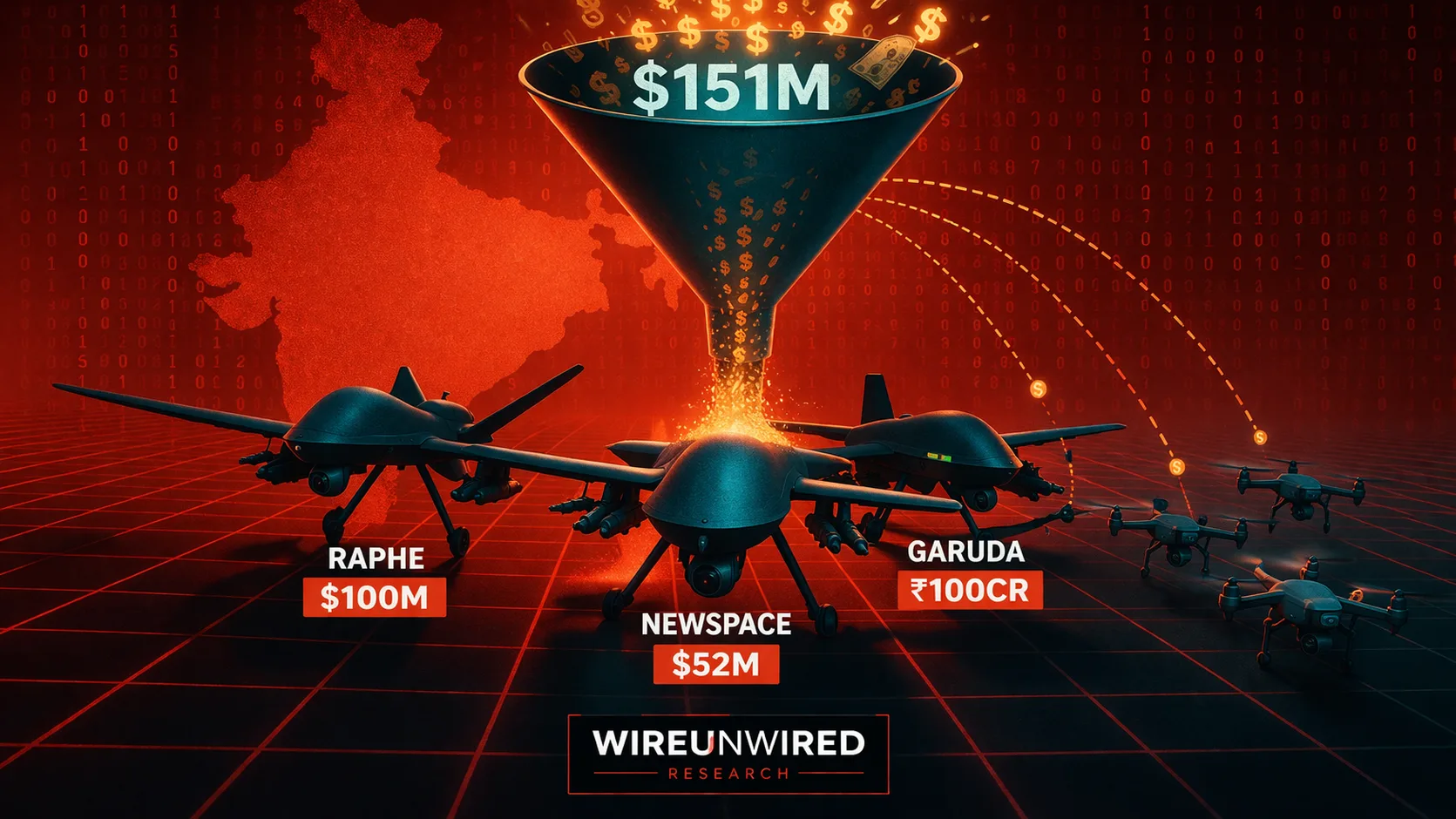

Indian drone startups raised $151 million over the past five years. That sounds like a healthy ecosystem until you realize three companies—all focused on defense and dual-use applications—account for the vast majority of that capital.
The concentration isn’t accidental. It’s a direct consequence of where the real money lives in India’s drone industry: not in delivering food or mapping farmland, but in building systems that can swarm, surveil, and strike.
Where the Money Actually Went ?
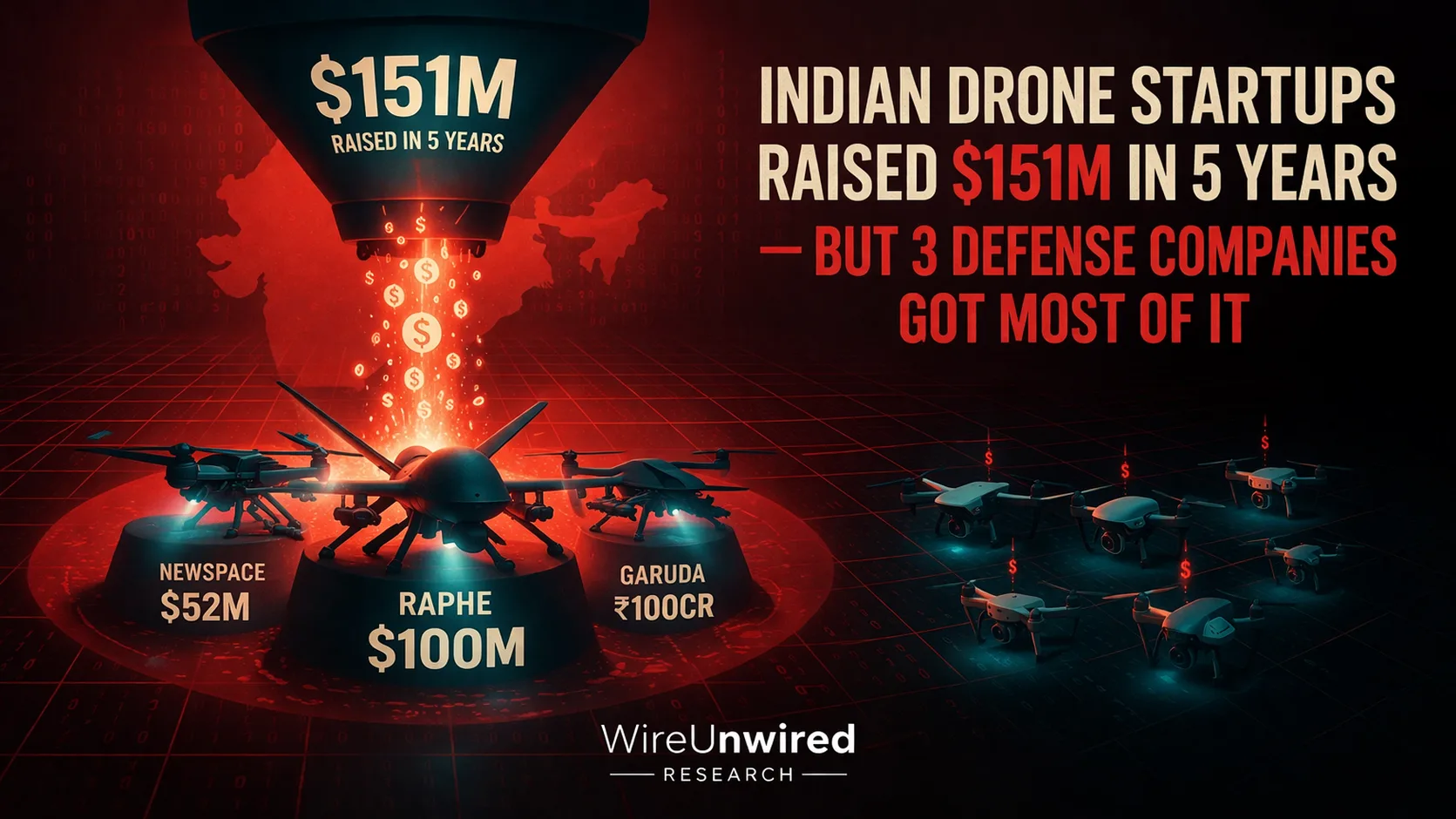
Three funding rounds tell the story of India’s drone capital markets between 2020 and 2025:
| Company | Amount Raised | Valuation | Primary Focus |
|---|---|---|---|
| Raphe mPhibr | $100M (June 2025) | ~$900M | Defense drone manufacturing |
| NewSpace Research | $52M (2024) | Not disclosed | Swarm drones, defense systems |
| Garuda Aerospace | ₹100 crore Series B (April 2025) | $250M | Multi-segment + expanding defense R&D |
Raphe mPhibr’s $100 million round alone represents two-thirds of the total $151 million raised across the entire Indian drone startup ecosystem in five years, according to Venture Intelligence data cited in industry reporting. The company expanded its manufacturing facility from 70,000 square feet to 650,000 square feet—a near 10x increase in production capacity—with explicit focus on defense contracts and scaled manufacturing.
NewSpace Research & Technologies raised $52 million in a bridge round combining equity and debt, with active Ministry of Defence contracts and demonstrated capabilities in swarming systems. The company delivered tethered drone systems to the Indian Army and showcased high-altitude demonstrations that signal defense procurement as the primary revenue driver.
Garuda Aerospace presents a more diversified profile—serving 750+ commercial clients including Tata, Adani, HUL, Reliance, and L&T—but the Series B funding announcement explicitly mentioned expanding subsystem/component manufacturing and defense R&D alongside commercial operations. The company reported FY2024 revenue of ₹110.8 crore, making it one of the few Indian drone companies with publicly disclosed revenue figures approaching commercial scale.
Why Defense Dominates Funding ?
The concentration in defense-oriented companies isn’t random. It reflects three structural realities about India’s drone market that we’ve documented in previous coverage:
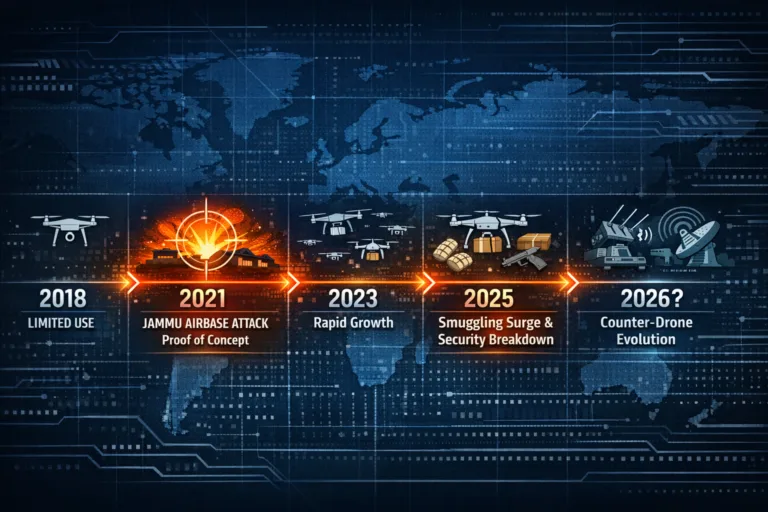
- Security demand is urgent and funded : As we detailed in our analysis of India’s drone security threats, the seizure of 272 smuggling drones and the 2021 Jammu air base attack created immediate procurement pressure for counter-drone systems, surveillance platforms, and swarm capabilities. Defense budgets move faster and larger than commercial customer acquisition when threats are operational rather than hypothetical.
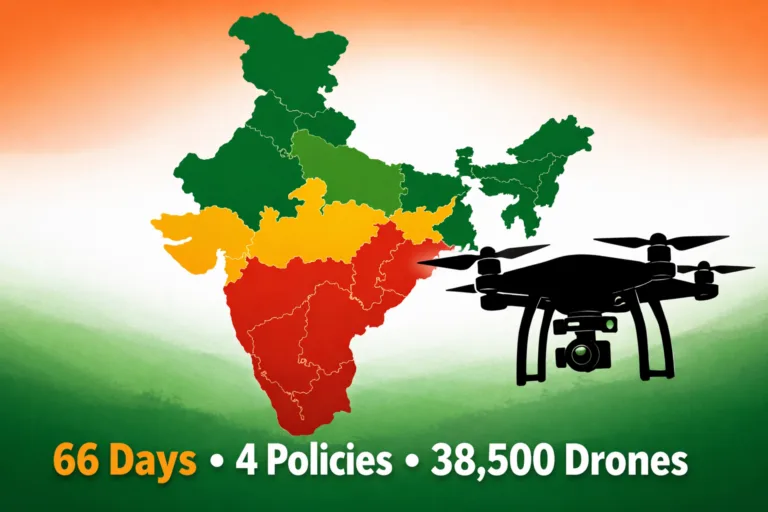
- Commercial use cases hit regulatory walls : The green zone system we explained in our regulatory deep-dive enables agricultural spraying and rural mapping beautifully. But urban delivery—the use case that attracts Silicon Valley-style venture funding globally—remains stuck because yellow zones around airports create permission friction that kills the economics of high-frequency logistics. VCs don’t fund businesses that need ATC clearance for every delivery.
- Component localization requires capital at scale: India’s import ban on foreign drones combined with PLI incentives created manufacturing momentum, but deep component localization—flight controllers, motors, sensors, batteries—requires sustained R&D investment and production volume. Defense contracts provide both: committed offtake agreements and multi-year revenue visibility that justify the capex
What This Means for the Civil Drone Ecosystem ?
The funding concentration creates a challenging dynamic for startups building civil applications. If you’re developing agricultural analytics software, inspection automation tools, or delivery network orchestration platforms, you’re competing for venture capital against defense companies showing massive rounds at unicorn-track valuations.
The typical civil drone startup story looks like this:
• Bootstrap or raise small angel/seed rounds (₹2-5 crore)
• Build revenue through agricultural services or infrastructure inspection contracts
• Hit growth ceiling because margins are thin and scaling requires working capital for equipment + pilots
• Struggle to raise institutional Series A because VCs compare you to defense companies with $100M rounds
Meanwhile, companies like Garuda that serve commercial customers can raise at scale partly because they’re also expanding into defense, creating a “you need defense exposure to raise big rounds” dynamic that pushes even civil-focused companies toward dual-use positioning.
This isn’t necessarily bad—dual-use technology development has legitimate benefits, and defense procurement can subsidize R&D that eventually benefits commercial applications. But it does mean India’s drone ecosystem is evolving differently from ecosystems in countries where e-commerce delivery or urban air mobility attract comparable venture capital.
The Companies You Don’t Hear About…
Beyond the headline rounds, India has dozens of drone companies operating at smaller scale with limited public funding disclosure:
Skylark Drones – focused on enterprise data analytics for mining, solar, and infrastructure, raised approximately $3 million in 2021 per some industry databases, though exact totals vary.
Asteria Aerospace, Dhaksha Unmanned Systems, Marut Drones, Throttle Aerospace Systems – all known participants in BVLOS trials and sectoral deployments, but reliable revenue or funding data isn’t publicly accessible for most.
ideaForge Technology – widely recognized for defense/public-safety ISR drones but specific funding/revenue disclosure limited in accessible sources.
The inability to populate detailed financial data for these companies is itself revealing. Unlike the defense-oriented players that announce major rounds with valuations and facility expansions, most civil-focused drone companies either bootstrap through service revenue or raise quiet rounds that don’t generate press coverage. This creates perception gaps where the ecosystem looks smaller and less diverse than it actually is operationally.
What Shifts This Dynamic ?
For funding concentration to decrease and civil applications to attract comparable capital, three things likely need to happen:
- UTM infrastructure operationalization: Until real-time traffic management, remote identification, and dynamic deconfliction work at scale—not just on paper—BVLOS delivery and urban logistics remain regulatory science projects rather than investable businesses. We’ve covered why this infrastructure lags despite policy intent existing since 2021.
- Clearer commercial exit paths: Defense companies have obvious exit options: continued government procurement, potential listing on defense-focused indices, or acquisition by larger defense primes. Civil drone service companies need demonstrated M&A activity or public market receptivity to create comparable exit visibility for VCs.
- Margin improvement in service models : Agricultural spraying and inspection services are real businesses serving real customers, but margins are compressed by equipment costs, pilot salaries, and customer acquisition friction. Until unit economics improve through automation, better tooling, or premium service tiers, these businesses struggle to justify venture-scale fundraising.
India’s drone startups have raised $151 million in five years. That capital created real manufacturing capacity, demonstrated technical capabilities, and built revenue-generating businesses across multiple segments. But the concentration in three defense-oriented companies reveals where investors see the clearest path to returns: not in the green zones enabling agricultural transformation, but in the security imperatives driving defense budgets and dual-use procurement.
The regulatory framework built in 2021 created possibility for both trajectories. Whether civil applications can attract comparable capital depends on infrastructure maturation, regulatory evolution, and business model innovation that shifts unit economics enough to compete with defense contracts for investor attention.
Related reading:
• How India Built a Drone Industry in 5 Years – Why the 2021 regulatory framework enabled this funding.
• India Seized 272 Smuggling Drones in 2025 – Security threats driving defense procurement
For discussions on drone startup funding, defense procurement, and venture capital strategy, join our WhatsApp community.
Discover more from WireUnwired Research
Subscribe to get the latest posts sent to your email.