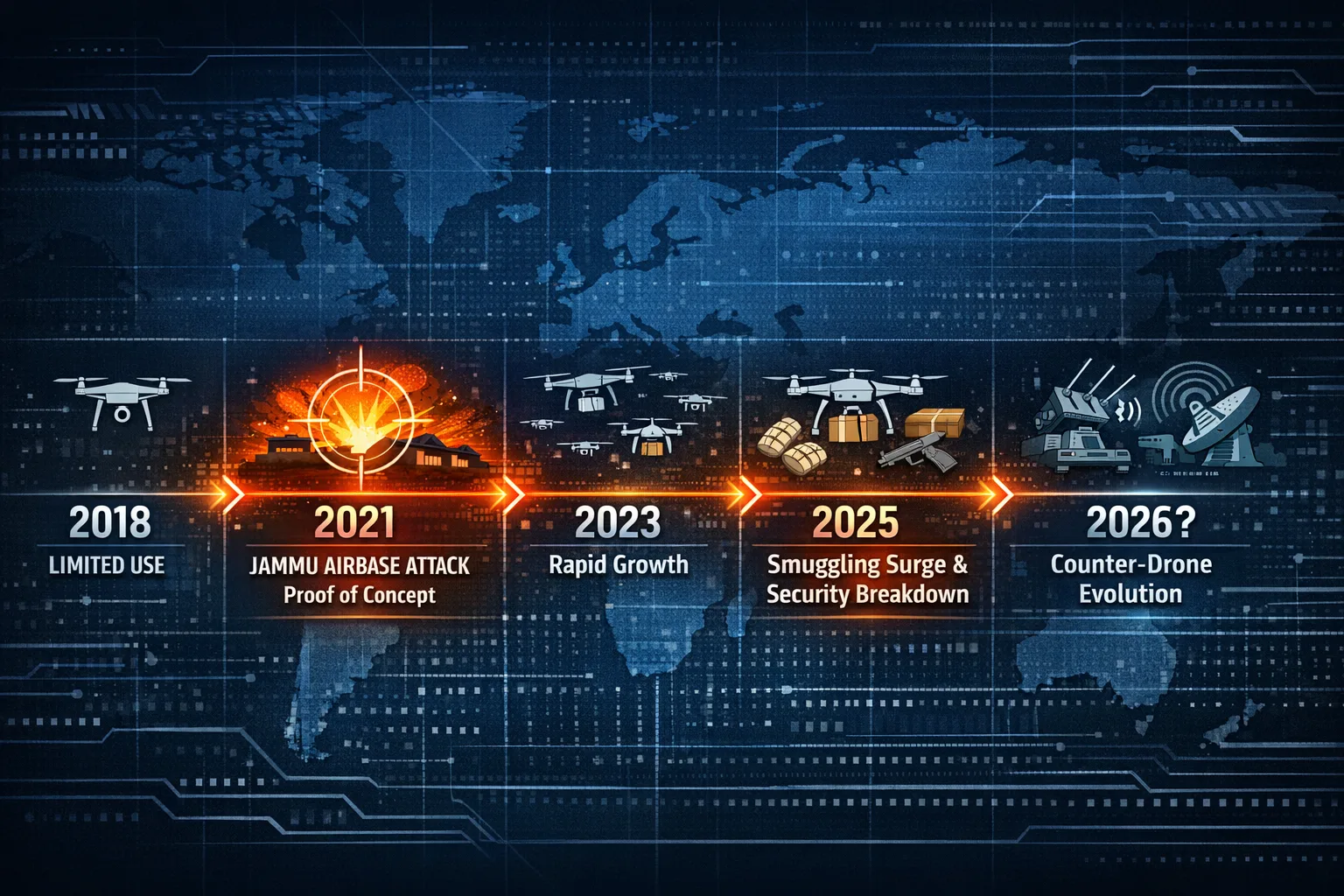

Between January and November 2025, India’s Border Security Force seized 272 drones and recovered over 367 kilograms of heroin along the Punjab border alone. That’s nearly one drone intercepted every day for eleven months straight — each carrying narcotics, weapons, or surveillance equipment across the international boundary. And these are just the ones that were caught.
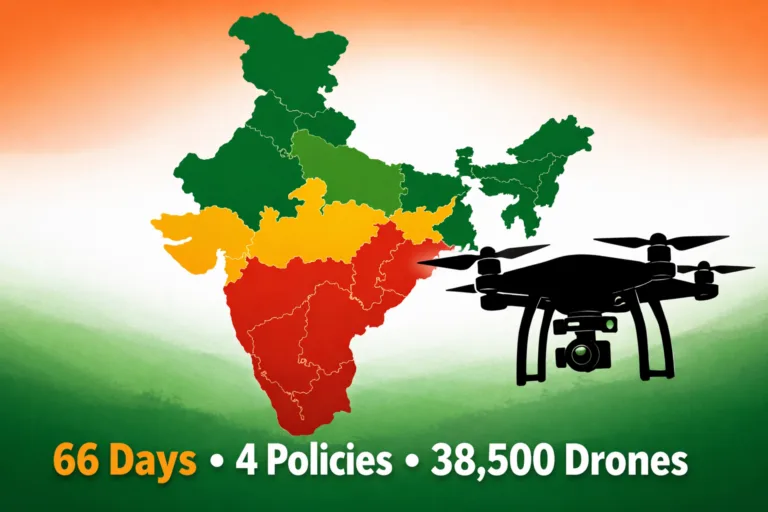
From a few hundred registered drones pre-2021 to 38,500 by February 2026, India’s drone industry exploded. But the same regulatory liberalization that enabled agricultural spraying, village mapping, and infrastructure inspection also handed hostile actors a playbook they’re running daily. The 2021 regulatory transformation we documented previously made legitimate drone operations predictable and scalable. It made illegitimate ones harder to catch until they’re already happening.
The threat isn’t future-tense. It’s here, it’s operational, and it’s getting more sophisticated every year.
The Threat Is Already Here
The 272 seized drones weren’t military hardware. Most are commercial quadcopters — DJI Phantoms, Mavics, and similar off-the-shelf models — modified to carry contraband packages weighing 2–5 kilograms. The playbook is almost insultingly simple: launch after dark, fly low below radar, GPS-drop the package at a predetermined location, return. If intercepted, just abandon the drone. At $1,000–3,000 per unit, that’s acceptable overhead when one successful heroin delivery pays for several replacements.
The 367+ kilograms recovered only tells you what was stopped. What crossed undetected is unknown — but based on how drug market economics and seizure rates work, it’s likely far more.
The harder problem is that you can’t just ban drones near the border. The green zone system that lets agricultural drones spray crops near Punjab without prior permission — genuinely useful, genuinely necessary for farmers — creates the exact same operational freedom smugglers exploit. BSF is stuck defending a line that legitimate commerce also needs to cross freely.
Then came June 2021, and the nature of the threat shifted. Two explosive-laden commercial drones struck the IAF technical area at Jammu air base — limited damage, but an enormous proof of concept. These weren’t sophisticated weapons. They were commercial models carrying improvised explosives. They succeeded because military installations built to stop aircraft, missiles, and ground threats simply weren’t designed to track slow, low-flying quadcopters. The attack forced a reckoning across Indian armed forces. But the hardware response exposed something that hardware alone can’t fix.
A Framework Built for Growth, Not Security
Here’s where it gets complicated. Five agencies share counter-drone authority — BSF at borders, state police for law enforcement, airport authorities, the Air Force and Army at military installations, and civil aviation regulators watching over manned aircraft. Coordination looks fine on paper. Under real operational pressure, when you have seconds to decide, it falls apart.
The technical options aren’t clean either. RF jamming disrupts legitimate communications. Net capture needs line-of-sight at close range. Kinetic takedowns create falling debris and misidentification risks near populated areas. And nobody has clearly answered the most basic question: if a security guard at a power plant spots a suspicious drone overhead, can they legally do anything about it? Current regulations don’t say. That hesitation — in a situation that doesn’t allow for it — is itself a vulnerability.
The cybersecurity side is a problem most operators haven’t even started thinking about. GPS spoofing — which can redirect a drone mid-flight to a completely different location — requires software-defined radio equipment that costs under $1,000. Command-and-control hijacking can hand full control of a drone to an attacker. Insecure apps leak flight plans and operator locations. Supply chain compromises can embed backdoors at the hardware level before a drone even reaches the buyer. India’s national incident response agency CERT-In published drone-specific security guidance precisely because this is real and underappreciated.
The problem is that most commercial operators — especially the smaller agricultural and inspection services scaling fast under the Drone Shakti initiative — treat drones like flying cameras, not networked computers. And the 2021 regulatory framework didn’t push back on that. It was built to enable growth: simplified permissions, Digital Sky integration, light compliance requirements. Mandating heavy security features early would have raised costs and slowed adoption. That tradeoff made sense then. It’s harder to defend now, as operations push toward autonomous BVLOS flights near critical infrastructure.
The September 2025 draft Civil Drone Bill does anticipate counter-drone and rogue UAS provisions — which at least signals that policymakers know the current setup needs to evolve. But as of early 2026, the specifics are still being worked out while the industry keeps scaling.
The Dilemma
India is caught between two things it can’t easily have at the same time. Tighten security — mandatory encryption, hardware-enforced geofencing, real-time remote ID, operator background checks — and you raise compliance costs, slow innovation, and gut the light-touch approach that built a $4.84 billion industry. Leave things as they are, and hostile actors keep exploiting the same openness that legitimate operators depend on.
There’s no clean answer. Comprehensive border interdiction would require radar coverage, RF detection systems, and rapid response teams across thousands of kilometers — expensive, and still imperfect. Banning drone flights near borders would gut Punjab agriculture. Neither extreme works.
What does work — at least directionally — is building security architecture on top of what already exists. Technical standards, enforcement capability, multi-agency coordination layered onto the 2021 enablement foundation, without strangling the commercial ecosystem that makes the whole thing worth protecting.
India seized 272 smuggling drones in 2025. That number will go up in 2026 unless counter-drone capabilities start outpacing the tactics being used against them. The window to get ahead of this is narrowing fast.
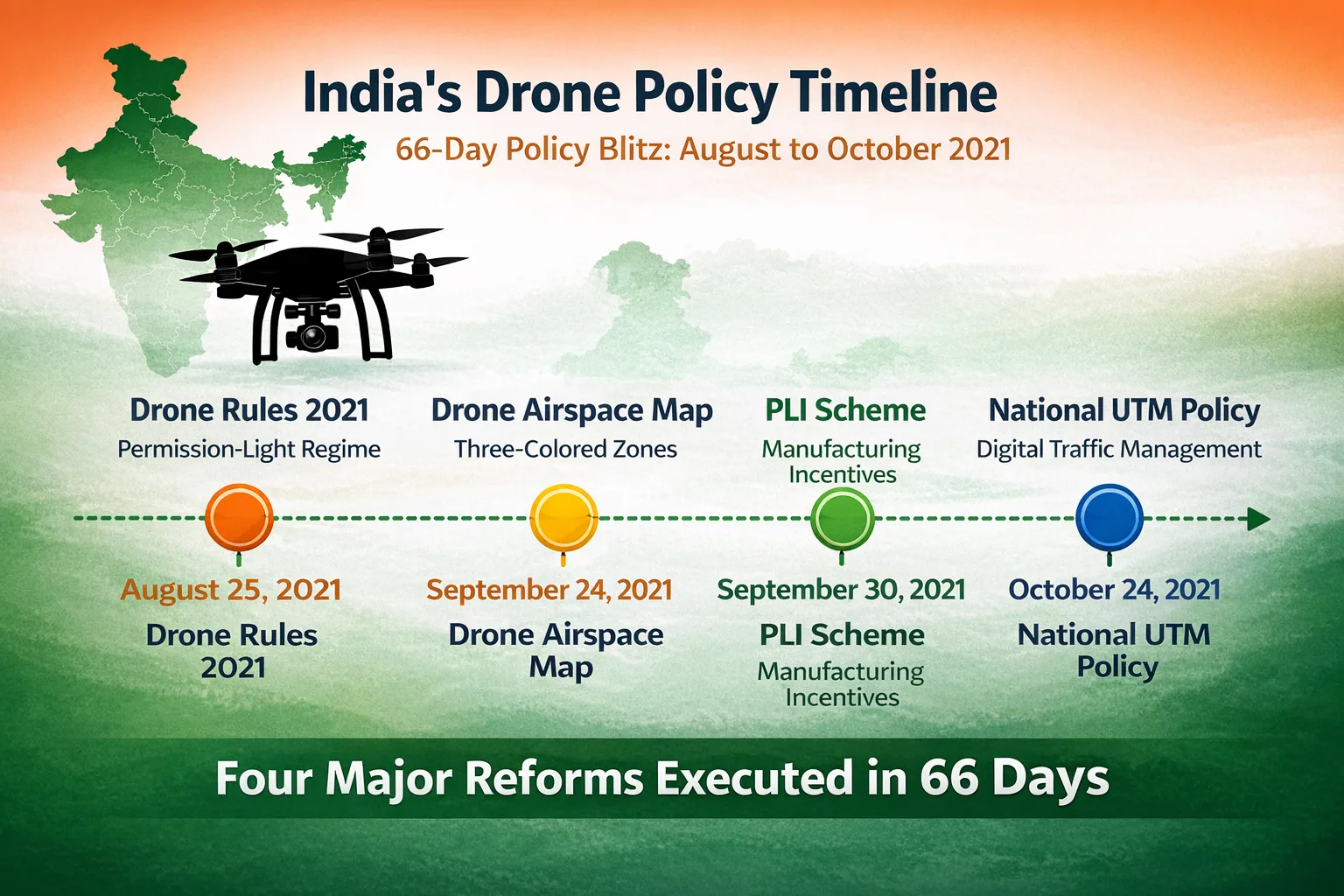
Related: Learn how India’s 2021 regulatory transformation created the foundation for this drone boom — and the security challenges that came with it — in our previous deep-dive: How India Built a Drone Industry in 5 Years
For discussions on drone security, counter-UAS technology, and policy implications, join our WhatsApp community where security analysts track developments in real time.
Discover more from WireUnwired Research
Subscribe to get the latest posts sent to your email.