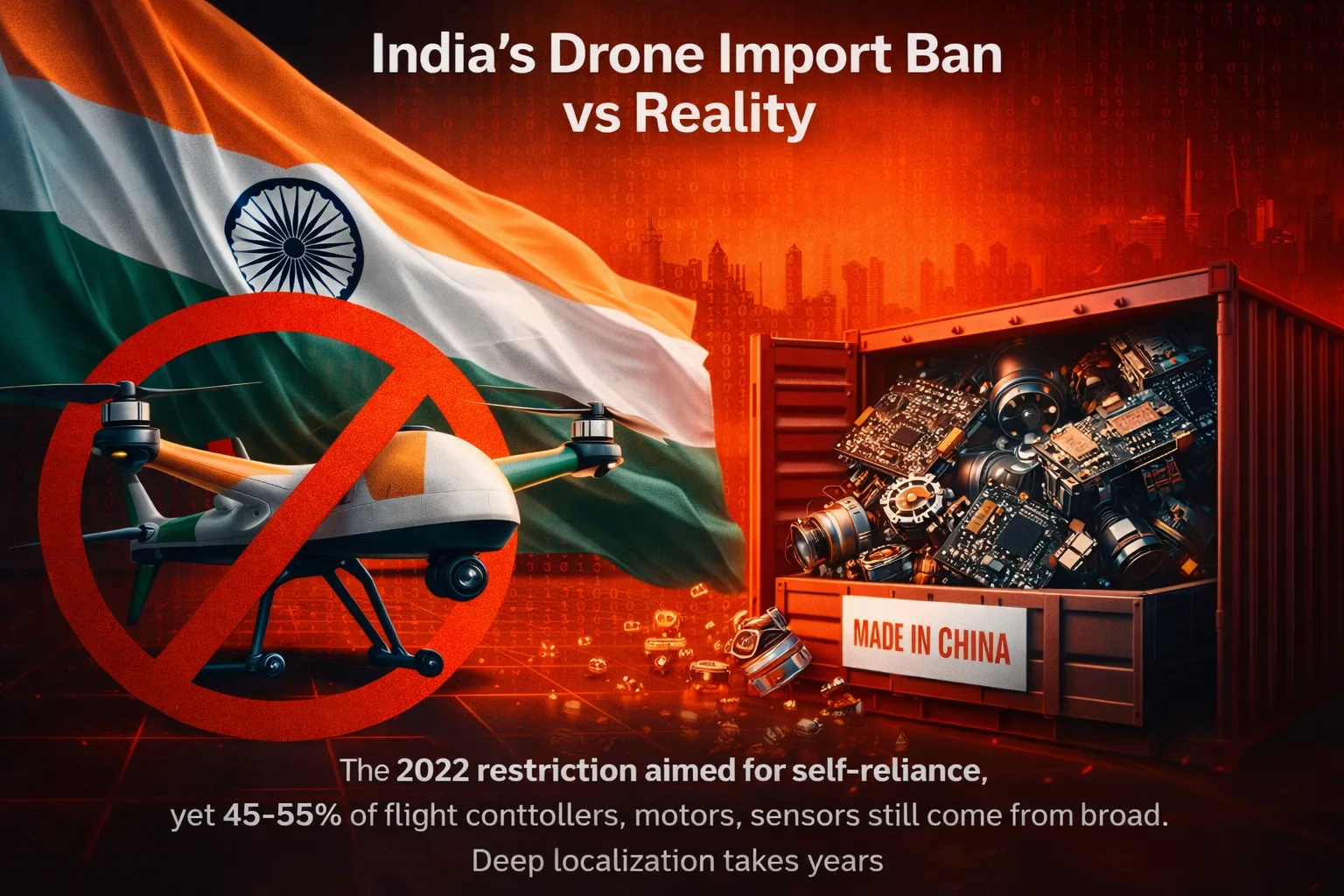

India banned imports of foreign-made drones in February 9 2022. The policy was clear: build domestic manufacturing capacity, reduce dependence on foreign suppliers, address security concerns about embedded electronics from untrusted sources. A year later, the government launched PLI incentives worth ₹120 crore to accelerate local production. Manufacturers expanded facilities, hired engineers, and announced ambitious indigenous content targets.
Then Garuda Aerospace’s founder said the quiet part out loud: 45-55% of critical components required for drone manufacturing are still imported.
This isn’t a policy failure. It’s the hard reality of what “Make in India” actually means when you’re trying to build a technology-intensive manufacturing ecosystem from near-zero in five years.
What Gets Assembled vs What Gets Imported
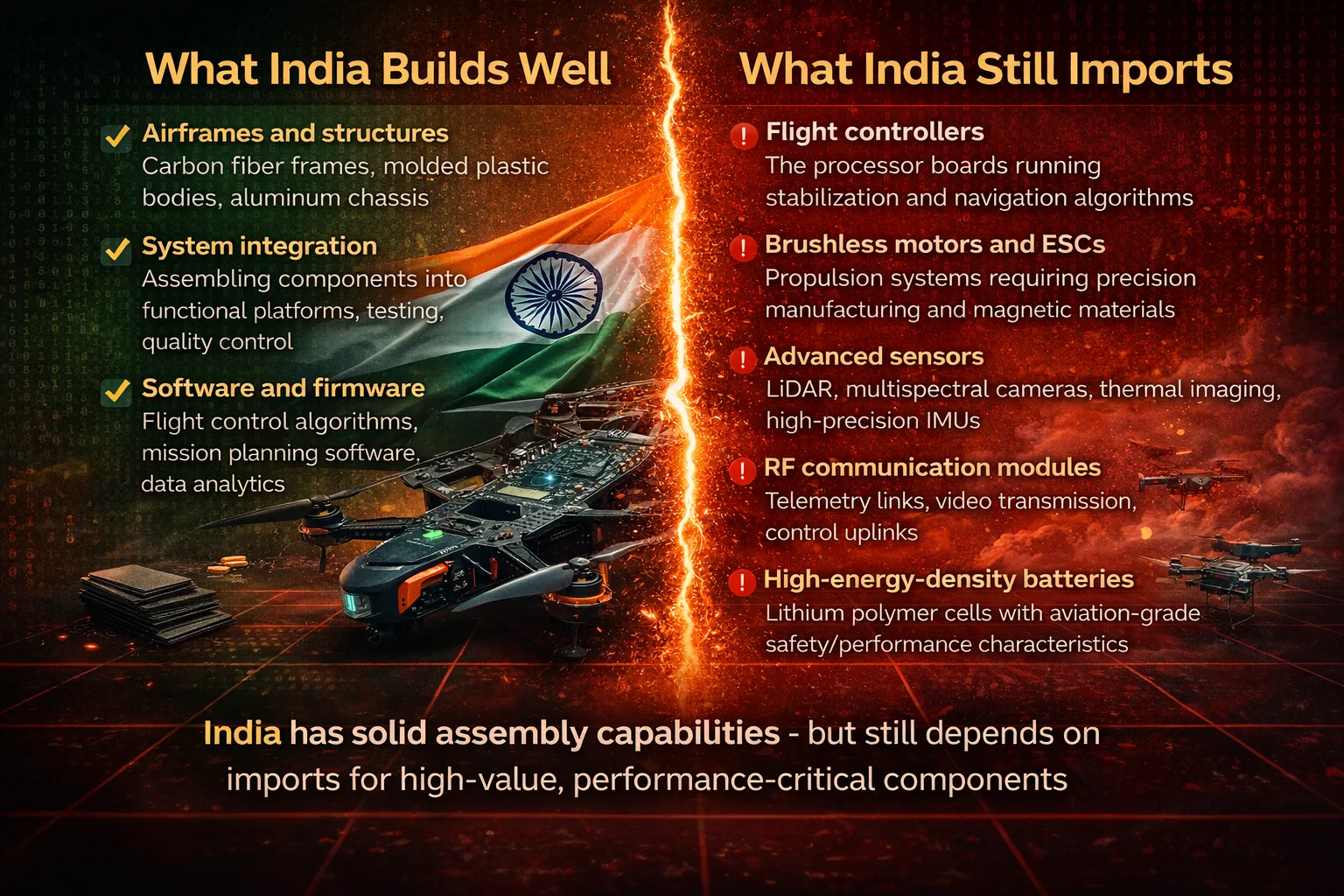
Understanding the supply chain paradox requires distinguishing between what Indian manufacturers can build domestically versus what they must import. The capabilities break down clearly:
What India builds well ?
• Airframes and structures – Carbon fiber frames, molded plastic bodies, aluminum chassis
• System integration – Assembling components into functional platforms, testing, quality control
• Software and firmware – Flight control algorithms, mission planning software, data analytics
• Final assembly – Integration, calibration, certification, packaging
What India still imports ?
• Flight controllers – The processor boards running stabilization and navigation algorithms
• Brushless motors and ESCs – Propulsion systems requiring precision manufacturing and magnetic materials
• Advanced sensors – LiDAR, multispectral cameras, thermal imaging, high-precision IMUs
• RF communication modules – Telemetry links, video transmission, control uplinks
• High-energy-density batteries – Lithium polymer cells with aviation-grade safety/performance characteristics
This split creates what industry insiders call “shallow manufacturing”—real production capability in assembly and integration, but deep import dependence for the components that determine performance, reliability, and cost structure.
Why Component Localization Is Hard ?
When the import ban and PLI scheme were announced as part of the 2021 regulatory transformation we’ve documented, the assumption was simple: ban foreign drones, create domestic demand through regulations, offer incentives, and component manufacturing would follow naturally. It hasn’t. Here’s why:
1. The Volume Problem
Building a flight controller manufacturing line requires $2-5 million in equipment: pick-and-place machines, reflow ovens, testing rigs, clean rooms. But India’s entire drone industry in 2024-2025 needed maybe 50,000-100,000 flight controllers annually across all manufacturers combined.
Global component makers serve markets of millions of units. At Indian volumes, the math doesn’t work. You can’t justify dedicated production lines when capacity would sit idle 80% of the time.
2. Precision Manufacturing Takes Years, Not Months
A brushless motor for drones isn’t just a small electric motor. It requires:
• Precise magnetic field design
• Tight tolerance machining (micron-level)
• Balanced rotors to prevent vibration
• Quality control processes that catch defects before flight
Chinese and Korean manufacturers spent 5-10 years perfecting these processes. India doesn’t have that institutional knowledge yet because the demand didn’t exist before 2021. You can’t compress a decade of manufacturing learning into eighteen months just because policy changed.
3. IP and Design Knowledge Aren’t For Sale
The best flight controllers come from companies like DJI, Pixhawk, and Cube that spent years refining:
• Sensor fusion algorithms
• Vibration isolation techniques
• Thermal management
• Fail-safe protocols
Indian startups can license designs or reverse-engineer, but catching up on performance and reliability and cost simultaneously is genuinely difficult when established players have massive R&D budgets and global scale advantages.
4. Supply Chain Ecosystems Have Network Effects
A flight controller manufacturer needs:
• PCB fabrication partners (with aviation-grade certifications)
• Microprocessor suppliers (consistent availability, not spot market)
• Sensor component makers (accelerometers, gyroscopes, magnetometers)
• Connector and passive component suppliers
• Testing and certification labs
These ecosystems exist in Shenzhen, Taiwan, and Korea because decades of electronics manufacturing created dense, mature supplier networks where you can source everything within a 50km radius. India is building that ecosystem, but it’s a 10-year project, not a 2-year sprint.
Security Implications of Import Dependence
The component import dependence isn’t just an industrial policy concern—it creates the exact security vulnerabilities the import ban was meant to address. As we detailed in our analysis of India’s drone security threats, CERT-In published specific guidance on drone cybersecurity because attack surfaces are extensive: GPS spoofing, command-and-control hijacking, firmware backdoors, supply chain compromises.
When you’re importing flight controllers, you’re importing firmware. When you’re importing RF modules, you’re importing communication protocols. When you’re importing sensors, you’re importing data processing pipelines. Each imported component is a potential vector for embedded backdoors, kill switches, or data exfiltration—exactly the supply chain risks that defense planners worry about when procurement goes to foreign suppliers.
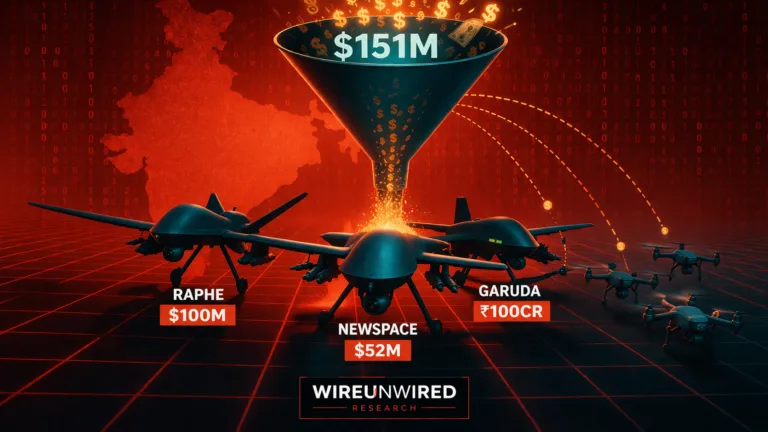
The defense-oriented companies attracting the majority of drone startup funding—Raphe mPhibr’s $100M round, NewSpace’s $52M, Garuda’s ₹100 crore Series B—all explicitly cite subsystem and component manufacturing expansion as funding use cases. This isn’t coincidental. Defense procurement requires supply chain transparency and often demands indigenous components for classified applications. The funding follows customers who care most about localization, which means defense contracts are subsidizing the component manufacturing buildout that commercial applications will eventually benefit from.
The Garuda Strategy: Vertical Integration
Garuda Aerospace’s response to the component import problem illustrates one viable path forward: vertical integration funded by scale and diversification. The company targets 85-88% indigenous content through expanded subsystem manufacturing while serving 750+ commercial clients across agriculture, infrastructure, and industrial sectors to generate revenue that funds R&D.
This is classic industrial strategy—use high-volume commercial sales to build manufacturing scale, then invest margin into component development that reduces import dependence over time. It’s how Samsung went from assembling consumer electronics to making semiconductors, and how Chinese drone makers went from rebranding foreign components to building proprietary flight controllers.
But it requires sustained capital, patient timelines, and tolerance for lower margins during the investment phase. Not every drone startup can execute this playbook, especially civil-focused companies that lack defense contracts providing committed offtake and premium pricing.
What Actually Moves the Localization Needle
Reducing import dependence from 45-55% to 20-30% over the next three to five years isn’t about wishful thinking or more policy announcements. It requires coordinated action with measurable commitments:
1. Volume Commitments from Anchor Buyers
Government procurement—defense, police, agricultural departments, infrastructure ministries—needs to signal multi-year volume commitments that justify component manufacturing investments.
Example: The SVAMITVA program mapped 3.29 lakh villages and created massive drone demand. Future programs need to go further: specif indigenous component requirements (e.g., “80% of flight controllers must be India-made by Year 2”) that create predictable pull for domestic suppliers.
Without committed offtake agreements, no manufacturer will invest $5M in production lines.
2. Targeted PLI for Bottleneck Components
The current PLI scheme covers components broadly, but incentives need to specifically target the critical bottlenecks:
• Flight controller modules
• Brushless motor + ESC combinations
• Lithium battery cells (not just pack assembly)
• Advanced sensor modules (LiDAR, thermal, multispectral)
Make the economics work for component makers even at today’s lower volumes—subsidize the gap until scale arrives.
3. Dual-Sourcing Becomes Mandatory for Scale
Companies planning to manufacture thousands of units monthly can’t rely on single-source imports vulnerable to:
• Export controls (geopolitical disruptions)
• Supply chain shocks (COVID-style)
• Quality inconsistencies
• Currency fluctuations
Building qualified alternate suppliers—ideally domestic—becomes operational necessity, not policy compliance theater. Defense contracts already require this. Commercial procurement should follow.
4. Technology Partnerships, Not Reinvention
India won’t reinvent every component from scratch, and it shouldn’t try.
Smart localization means:
• License proven flight controller designs from established players
• Adapt them for local manufacturing (India-specific certifications, supply chains)
• Build capabilities incrementally—master motor manufacturing before attempting custom chip design
This is how South Korea built electronics manufacturing. This is how China built drone supply chains. Trying to do everything simultaneously guarantees mediocre results across the board.
India banned foreign drone imports in February 2022. Two years later, manufacturers still import 45-55% of critical components. This gap between policy intent and manufacturing reality isn’t failure—it’s the honest physics of building technology supply chains.
The import ban created protected space for domestic assembly and integration to develop without getting crushed by established global players. The PLI incentives funded facility expansion and hiring. The regulatory framework we documented created demand that justified investment. But deep component localization requires capital intensity, precision manufacturing capabilities, and supplier ecosystems that take years to build even when policy support is strong.
The question isn’t whether India will reduce component import dependence—defense procurement requirements and geopolitical realities ensure it will. The question is timeline and pathway: vertical integration by funded players like Garuda, targeted PLI for critical subsystems, technology licensing from global partners, or some combination creating an ecosystem where 20-30% import dependence becomes achievable by 2028-2030.
The 45-55% import reality today shows how far India has come in five years and how far remains to go. Acknowledging the gap honestly is the first step toward closing it.
Related reading:
• How India Built a Drone Industry in 5 Years – The 2021 import ban and PLI incentives
• Indian Drone Startups Raised $151M – Why defense funding targets component localization
• India Seized 272 Smuggling Drones – Security risks of imported components
For discussions on drone manufacturing, supply chain strategy, and component localization, join our WhatsApp community.
Discover more from WireUnwired Research
Subscribe to get the latest posts sent to your email.