

India built a functional drone industry in five years through a regulatory strategy that’s rare in government. From ripping up the permission-heavy regime, replacing it with a digital platform, zone the entire country’s airspace in three colors, ban foreign competition, and subsidizing domestic manufacturing. The remarkable part isn’t just what happened, but all of it executed between August and October 2021 in a concentrated 66-day policy blitz.
Four major policy moves landed within that window. The Drone Rules 2021 were notified on August 25, followed by the national drone airspace map on September 24, then a production incentive scheme(PLI Scheme) on September 30, and finally the national UTM policy framework on October 24. This wasn’t incremental reform or cautious experimentation. It was deliberate regulatory shock therapy designed to create an industry where almost none existed, and to do it fast enough that first-mover advantages would accrue to domestic players before global competitors could establish distribution.
By February 2026, the results were measurable: 38,500+ registered drones operating under proper licensing, 39,890 certified remote pilots trained and credentialed, 244 approved training organizations spread across the country, and a market projected to grow from $1.58 billion in 2024 to $4.84 billion by 2030. India went from restrictive permission requirements that choked commercial viability to what government documents call a “digitally mediated, light-touch” model—regulatory language that actually translated into something companies could navigate predictably enough to scale.
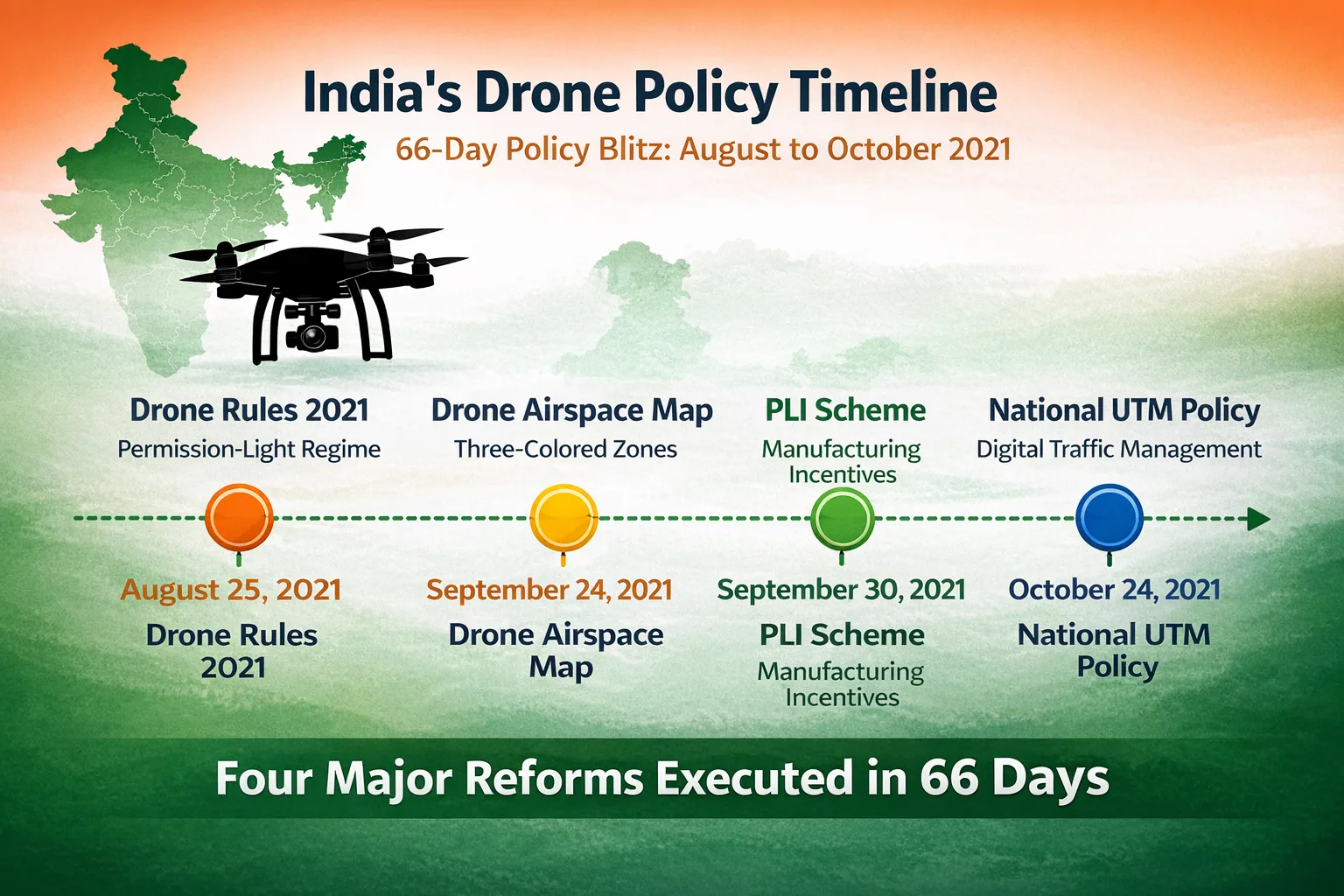
Drone Rules 2021: The Permission Purge
The Drone Rules 2021 represented a philosophical shift as much as a procedural one. Where the previous regime required proving why you should be allowed to fly, the new framework flipped the logic: we’ll tell you where you can’t fly, and everything else is permitted by default. Weight coverage expanded up to 500 kg, opening the door for larger cargo concepts and even passenger drone designs that were purely theoretical under earlier restrictions. Forms were simplified, fees reduced, foreign ownership constraints eased, and penalties made less punitive for minor violations.
The most important structural change was embedding Digital Sky—a single-window platform for registration, flight permissions, and airspace coordination—directly into the regulatory architecture. This wasn’t a parallel system or optional convenience portal. Digital Sky became the system of record, which meant drone regulation shifted from manual approval bottlenecks dependent on bureaucratic discretion to automated workflows where compliance could be verified programmatically.
Importantly, the draft consultation process before the final rules acknowledged that certain technical requirements—NPNT (No Permission No Takeoff), real-time tracking beacons, geo-fencing enforcement—would be notified later with adequate lead time. This staged approach gave manufacturers breathing room to design compliance into future product generations rather than facing overnight mandates that would obsolete existing inventory and kill early-stage companies before they could adapt.
Green, Yellow, Red: Zoning the Entire Country
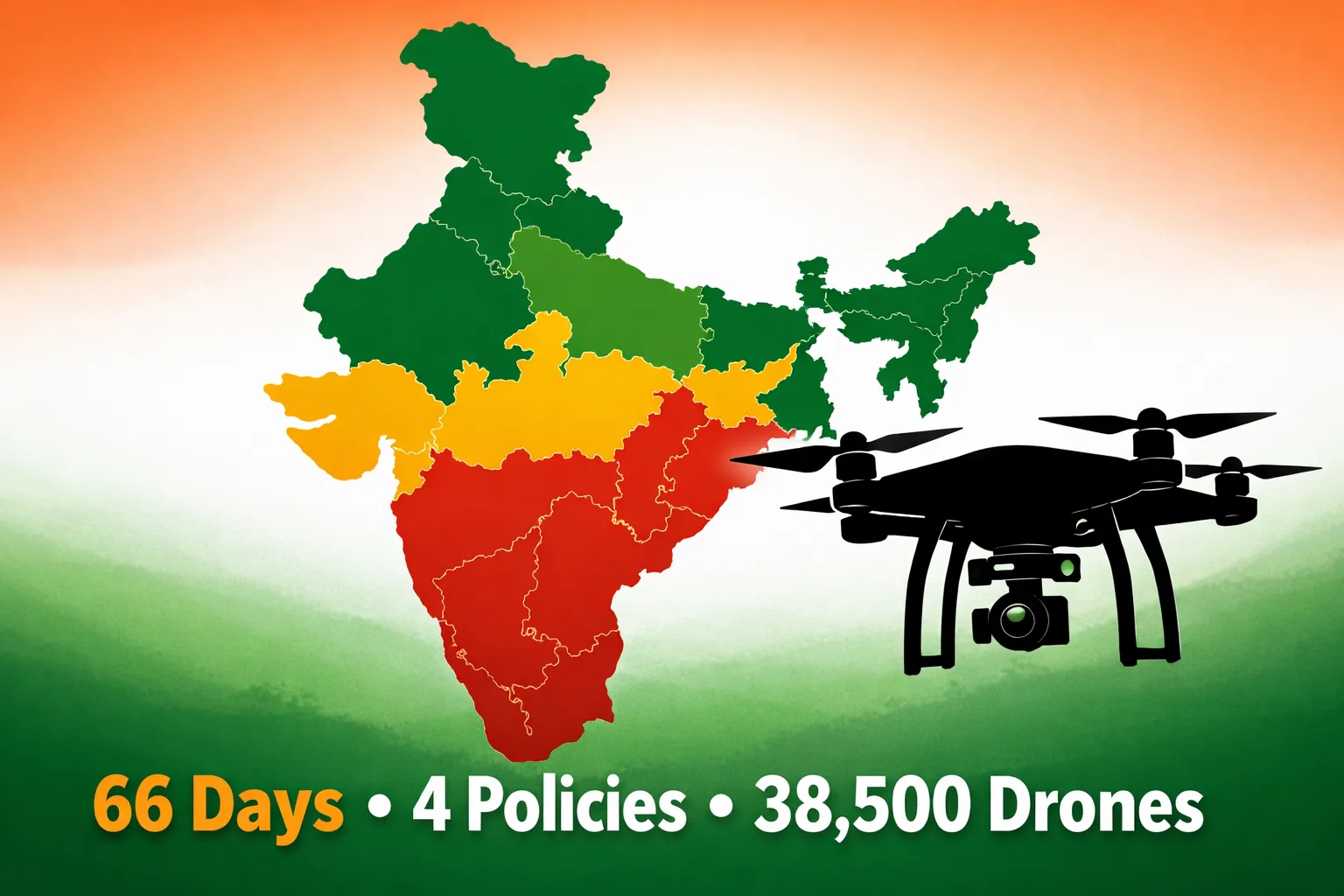
If the Drone Rules created the legal framework, the September 2021 airspace map made it operationally meaningful. India divided its airspace into three zones with radically different permission logic, each color-coded for quick reference.
Green zones cover areas generally up to 400 feet above ground level outside controlled airspace—no permission required for drones up to 500 kg operating under defined conditions. This is where commercial viability actually lives. Yellow zones encompass controlled airspace around airports, military installations with buffer zones, and approach paths where coordination with Air Traffic Control is required but structured and predictable. Red zones are no-drone areas requiring central government approval: international borders, certain strategic facilities, and sensitive security zones that are effectively prohibited for commercial operations.
This tricolor zoning system creates profound geographic inequality by design, though not in a way most people initially recognize. Use cases that naturally fit inside green zones—agricultural spraying across rural farmland, village-scale mapping for land records, inspection of highways or railways or pipelines far from urban centers—can scale rapidly because regulatory friction approaches zero. But urban delivery concepts that envision drones shuttling between neighborhoods constantly intersect yellow zones because cities have airports, and airports have large controlled airspace buffers. Every flight requires coordination, which kills the economics of high-frequency logistics.
This explains why SVAMITVA—the massive government land-mapping program—could survey 3.29 lakh villages using drones without hitting insurmountable regulatory walls, while a startup trying to deliver food across Bangalore faces structural headwinds from day one. The regulatory system isn’t neutral. It explicitly advantages certain use cases and geographies over others based on airspace classification.
The zoning system also incorporates dynamic elements: temporary red zones can be declared for major events, security situations, or airspace conflicts, with updates pushed through Digital Sky in near-real-time. This creates operational flexibility for authorities but potential unpredictability for commercial operators whose planned flight paths might suddenly intersect newly restricted areas.
Import Ban Plus Manufacturing Incentives
In February 2022, barely five months after the regulatory transformation began, India banned imports of foreign-made drones while explicitly allowing component imports to continue. This policy wasn’t just protectionism dressed up in security language, nor was it purely security concern masquerading as industrial policy—it was genuinely both, and the dual motivation shaped its design.
The companion policy had already been put in place: the PLI (Production Linked Incentive) scheme notified in September 2021, offering INR 120 crore across three years structured around a 20% incentive on eligible value addition. The scheme covered both drone manufacturers and component makers, with eligibility thresholds calibrated to encourage companies to achieve meaningful scale rather than stay subscale assemblers.
Government reporting later revealed that investment associated with PLI beneficiaries reached approximately INR 595 crore, one of the few official post-launch signals showing that the incentives translated into actual capital expenditure rather than just paper commitments. This mattered because it demonstrated genuine manufacturing capacity being built—factories, tooling, testing infrastructure, supply chain relationships—rather than hollow announcements.
But the import ban created a paradox that industry insiders understand well even if policy documents don’t emphasize it. Assembly and integration capacity scaled quickly. Companies could design airframes, integrate purchased subsystems, run testing protocols, and ship finished products to customers within months of committing to manufacturing. Deep component localization, however, lagged badly. Garuda Aerospace’s founder stated publicly that 45-55% of critical components required for drone manufacturing are still imported, even as the company targets 85-88% indigenous content through expanded subsystem manufacturing investments.
This means India’s drone manufacturing boom is real but shallow in a specific technical sense. The country has built strong capabilities in system integration—taking globally sourced components and assembling them into functional, certified, market-ready products. But critical electronics remain import-dependent: flight controllers that run stabilization algorithms, brushless motors and ESCs that provide propulsion, advanced sensor packages for navigation and obstacle avoidance, RF communication links, and high-energy-density batteries. These components expose Indian manufacturers to global supply chain disruptions, export control restrictions when geopolitics shift, and technology access constraints that no amount of domestic policy can immediately overcome.
Pilot Licensing and Training Scale-Out
A structural bottleneck disappeared in February 2022 when the Drone Amendment Rules shifted from DGCA-issued pilot “licenses” to Remote Pilot Certificates issued through authorized training organizations. This change decentralized what had been a single-agency chokepoint and allowed training capacity to scale horizontally across private and public providers simultaneously.
The numbers tell the scale-out story clearly. By February 2026, India had 39,890 certified pilots and 244 training organizations actively credentialing new operators. For context, pre-2021 pilot counts were measured in hundreds, not tens of thousands. This explosion in certified operators was deliberate policy, not organic growth. Drone Shakti, announced in the Union Budget 2022-23, explicitly promoted drone-as-a-service business models and embedded drone pilot training into existing skilling infrastructure like Industrial Training Institutes that already had national reach and government funding.
The speed of this expansion raises quality questions that don’t have clear answers yet. Rapid training scale-up across 244 organizations with variable resources, faculty expertise, and equipment quality creates risk of uneven instruction standards, weak standard operating procedure adherence, and eventually safety incidents that could trigger regulatory tightening. Government has established formal curriculum standards and testing requirements, but ensuring consistent enforcement across hundreds of training providers spread across diverse states and urban-rural contexts remains an ongoing challenge rather than a solved problem.
What This Regulatory Stack Enables and What It Doesn’t
India’s 2021 regulatory transformation created immediate enablement for specific use cases that had clear return on investment, low regulatory friction in green zones, and often direct government demand pulling the market forward. Agricultural spraying scaled across rural areas where farmers could hire drone service providers to cover large acreages faster and more uniformly than ground equipment. Rural land mapping exploded through SVAMITVA’s documentation of 3.29 lakh villages, creating millions of property records that never existed in formal systems before. Infrastructure inspection—railways, highways, power transmission lines, pipelines—found commercial traction because the value proposition was obvious and the operations happened in green zones away from urban airspace complexity.
What the regulatory framework hasn’t yet enabled is a different category of use cases entirely. Routine urban delivery remains stuck in pilot purgatory, where every trial requires special permissions and coordination across multiple agencies. Dense BVLOS operations—beyond visual line of sight flights happening continuously across defined corridors—exist in experimental form but not as scalable commercial reality. High-frequency logistics networks that would require hundreds or thousands of daily drone flights coordinating in shared airspace can’t operate because the underlying traffic management infrastructure doesn’t exist in production yet.
India designed that infrastructure on paper. The National UTM Policy Framework, issued in October 2021, lays out the architecture for software-based automation, real-time data exchange, dynamic deconfliction, and coordinated management of very low level airspace up to 1000 feet. But policy frameworks and operational systems are different things. Real-time identification and tracking of every drone in the air, automated conflict detection and resolution, integration with Air Traffic Control and military air defense networks, secure communication channels that can’t be spoofed or jammed—these capabilities require infrastructure buildout, testing, certification, and operational validation that takes years, not months.
The September 2025 draft Civil Drone Bill signals where this is heading. If enacted, it would shift India from facilitative rules designed to encourage industry growth toward statute-backed enforcement with mandatory safety features, insurance requirements, stronger penalty provisions, and formalized counter-drone governance. This isn’t backtracking on liberalization. It’s the natural progression as an industry matures from early adoption to dense operations where failures have larger consequences and security concerns become more acute.
India built a drone industry in five years not through gradual reform or careful pilot programs, but through concentrated regulatory redesign compressed into late 2021. The green zone system made commercial operations predictable enough for companies to invest confidently. The import ban combined with PLI incentives created protected space for domestic manufacturing to develop without getting crushed by established global players. Digital Sky automated compliance workflows that would otherwise drown startups in paperwork. Decentralized pilot certification broke training bottlenecks that would have capped operator supply.
But the next phase—moving from thousands of drones doing relatively simple tasks to hundreds of thousands executing complex coordinated missions in shared airspace—requires infrastructure and institutional coordination that policy intent hasn’t yet translated into operational reality. India has the regulatory foundation. Whether it can build the UTM infrastructure, enforcement capability, and multi-agency security architecture on top of that foundation will determine if the industry scales from early commercial traction to genuine mass adoption. The 2021 transformation created the possibility. The next five years will show whether the possibility becomes reality.
For discussions on drone policy, Indian manufacturing, and regulatory strategy, join our WhatsApp community where policy analysts discuss developments.
Discover more from WireUnwired Research
Subscribe to get the latest posts sent to your email.