
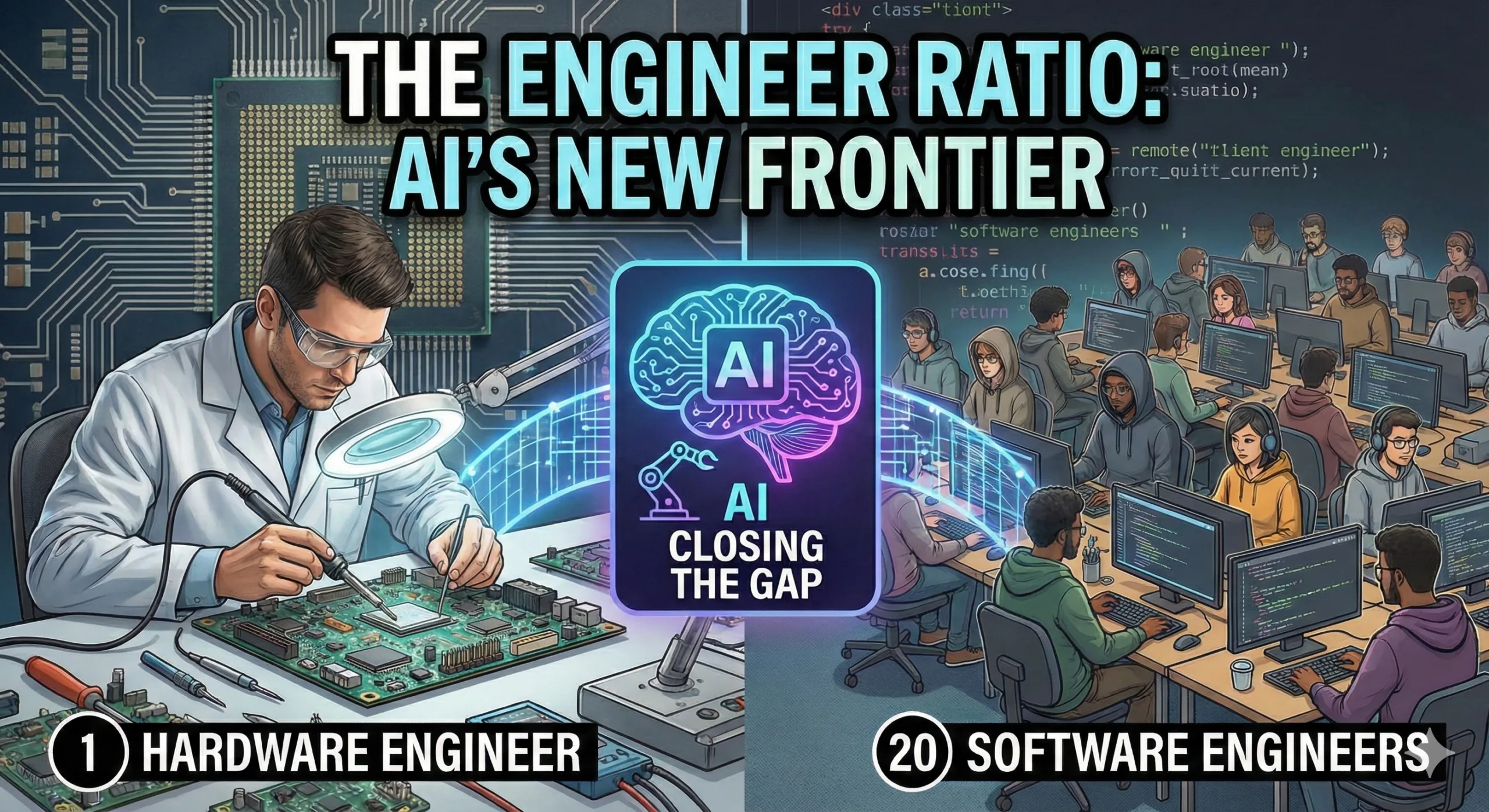

There are roughly 2 million software engineers in the United States and there are less than 100,000 engineers who design chips. That 20:1 ratio isn’t just a talent shortage statistic—it’s the defining constraint on how fast the semiconductor industry can grow, and increasingly, the problem the entire industry is trying to solve with AI.
The demand side keeps intensifying. AI chips, automotive silicon, edge computing devices, and data center processors all require hardware engineers with deep expertise in digital logic, timing, verification, and physical design. Universities can’t produce them fast enough. Companies can’t find them fast enough. And the engineers that do exist command salaries that startups and mid-size firms struggle to match against Google, Nvidia, and Apple.
So the industry is attempting something ambitious: using AI to turn software engineers into hardware designers.
The logic isn’t as crazy as it sounds. Twenty-five years ago, hardware engineers who knew object-oriented programming became verification engineers because that skill combination was suddenly valuable. The same transition is happening again. AI tools are abstracting away the most complex parts of hardware design—RTL coding, testbench generation, timing closure—making it possible for engineers without deep hardware backgrounds to contribute meaningfully to chip development.
“Maybe chip developers will no longer need to learn how SystemVerilog works or how VHDL works,” said Matthew Graham, senior group director at Cadence. “
They’ll have some fundamental understanding, in the same way that people writing C++ or Python fundamentally understand that the compiler creates machine code. They don’t have to do it. They just have to understand that when they write this code, these things happen under the hood.”
⚡
WireUnwired • Fast Take
- 20 software engineers exist for every 1 hardware engineer in the US
- AI tools abstracting hardware design—software engineers increasingly able to contribute
- UCLA undergrads designing CNN accelerators in 1.5 weeks using high-level synthesis
- Key warning: don’t fear AI replacing you—fear people who use AI effectively replacing you

The most striking proof point comes from UCLA. Professor Jason Cong has been working on this problem for two decades. In his undergraduate CS-133 course, students with software backgrounds use high-level synthesis tools to design CNN accelerators on AWS cloud infrastructure—in one and a half weeks. What used to require years of hardware expertise now takes freshman engineers ten days with the right tools and abstractions.
This isn’t about replacing hardware engineers. It’s about expanding the pool of people who can contribute to chip design. Agentic AI systems connected to design history and previous project data can guide engineers through unfamiliar territory, flag problems they’ve never encountered before, and suggest optimizations that would otherwise require deep domain expertise.
“The more data you feed it, the more it knows exactly what to do,” said Sathishkumar Balasubramanian at Siemens EDA. “The knowledge becomes universal.”
But senior hardware expertise doesn’t disappear—it becomes more valuable. “We’re seeing fewer entry-level, junior engineers,” said Kexun Zhang, head of research at ChipAgents. “Software engineers with lots of experience are valued because AI essentially is a tool. You can do greater things with better tools, but you still need the person using the tool to understand the problem well in order to architect whatever they’re designing.”
Companies are already hiring around this reality. Keysight EDA takes strong CS graduates and trains them on hardware fundamentals, or hires strong hardware engineers and upskills them on software. ChipAgents staffs 50% CS and AI graduates alongside 30-40% computer engineering graduates, with senior EDA veterans on the advisory board providing domain depth. The combination—AI-native software talent plus experienced hardware guidance—is becoming the template.
Universities are adapting, if slowly. Engineering programs are more connected to industry needs than they were a decade ago, though the lag remains significant. The debate isn’t whether to shorten degree programs—most experts say no—but whether to pack more relevant skills into existing timelines. Three years of engineering education enhanced by AI tools should produce better graduates than three years without them, not faster graduates with less depth.
The real warning for anyone in this industry—hardware or software—comes from Andy Nightingale at Arteris:
“There shouldn’t be a fear of AI coming in to replace people’s roles. It should be a fear of people knowing how to drive AI effectively coming in to replace their roles.”

The 20:1 ratio won’t disappear overnight. Hardware design requires domain knowledge that AI tools can assist but not replace entirely. What changes is the threshold for contribution—the floor of expertise needed to meaningfully participate in chip development is dropping, while the ceiling for what experienced engineers can accomplish with AI assistance keeps rising. The shortage won’t be solved by AI alone. But the industry’s best bet for closing a 20:1 gap is making every hardware engineer dramatically more productive, while bringing software engineers into the fold faster than traditional training ever allowed.
For discussions on semiconductor talent, chip design education, and AI-assisted engineering, join our WhatsApp community where engineers and educators discuss industry trends.
Discover more from WireUnwired Research
Subscribe to get the latest posts sent to your email.